After Dark Diaries | Antiquities No. 2


We like to think we have a reasonable idea of how the world works.
Rocks stay where they’re put. Fish need water. Caterpillars are generally better off avoiding spiders, and if somebody builds a unicorn skeleton, you’d be forgiven for assuming the bones weren’t real.
Unfortunately, reality doesn’t always cooperate.
Look closely enough and you’ll find creatures surviving by methods that seem impossible, objects moving when nobody is watching, evidence of life we still can’t comfortably place on the family tree, and traces of ordinary people that somehow survive thousands of years after almost everything else about them has disappeared.
Then there are the things happening far beyond our own planet. Even something containing the mass of a million Suns can apparently wander around unnoticed until it makes the unfortunate decision to eat a star.
That’s what this second collection of Antiquities is about.
Not myths dressed up as facts, or mysteries made more mysterious for the sake of a good story. This time, we’re wandering through some of the peculiar, beautiful, ingenious and occasionally ridiculous things that really exist.
Because the more we discover about our world and everything beyond it, the harder it becomes to escape one rather wonderful conclusion:
The world really is stranger than you think.
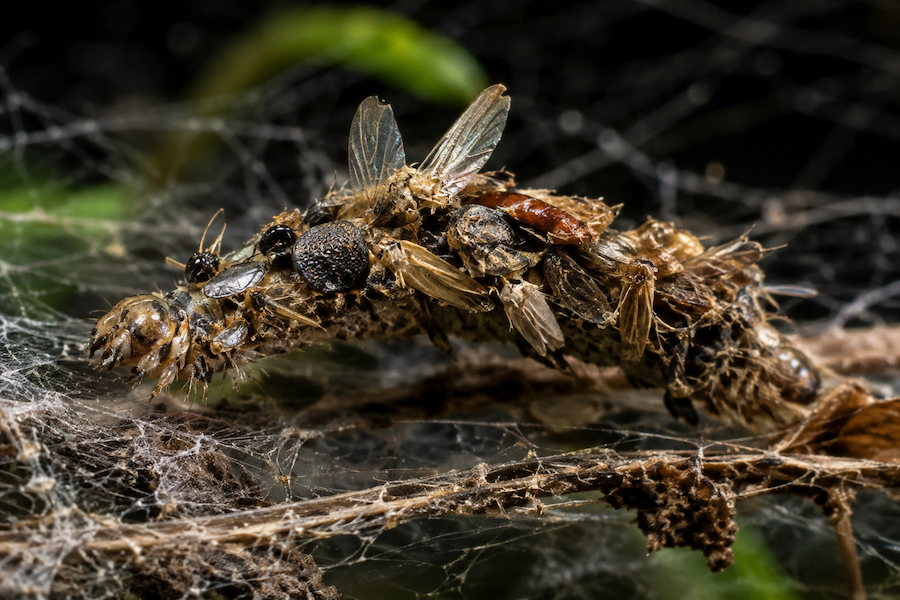
Most caterpillars spend their lives eating leaves and trying not to be eaten themselves. On the Hawaiian island of Oʻahu, however, scientists have discovered one that seems to have abandoned both conventions.
The so-called bone-collector caterpillar is carnivorous. It lives in and around spiders’ webs, where it feeds on weakened or recently dead insects caught by the spider. Researchers have even watched it chew through strands of webbing to reach a meal.
But that isn’t what earned it its name.
Like other Hawaiian Hyposmocoma caterpillars, it carries a protective silk case around with it. This species decorates that case with pieces of dead insects. Researchers have observed individuals carefully measuring and attaching fly wings, weevil heads, earwig abdomens and other fragments of the spider’s previous meals.
Quite why it does this isn’t yet certain. One possibility is that surrounding itself with material already familiar to the spider helps disguise the caterpillar’s presence. If so, it may effectively be wandering through a predator’s home dressed as its leftovers.
The creature is also extraordinarily rare. Despite decades of searching, researchers have found it in only about 15 square kilometres of forest in Oʻahu’s Waiʻanae mountain range. Its evolutionary lineage appears to be at least six million years old, suggesting its ancestors may once have lived on older Hawaiian islands that have since largely disappeared beneath the Pacific.
There are roughly 150,000 known species of butterflies and moths, and only a tiny fraction have carnivorous caterpillars. None other is known to live this way.
After millions of years of evolution, one tiny Hawaiian caterpillar has ended up living with spiders, eating their leftovers and covering itself in the remains.
And somehow, the spider isn’t the unsettling one in this story.
Supermassive black holes are normally found at the centres of galaxies. They can contain the mass of millions or even billions of Suns, yet unless they are actively feeding, they can be extraordinarily difficult to see.
So imagine astronomers’ surprise when they found one thousands of light-years from the centre of its galaxy.
The object, associated with an event known as AT2024tvd, lies roughly 600 million light-years from Earth. Instead of sitting neatly at the centre of its host galaxy, the black hole is around 2,600 light-years away from the galactic centre. Astronomers now estimate that it contains roughly a million times the mass of our Sun.
For something so enormous, however, it had managed to remain remarkably well hidden.
Then a star wandered too close.
The black hole’s gravity began pulling the star apart in what astronomers call a tidal disruption event. The doomed star was stretched and shredded, while some of its material formed a fiercely hot disc around the black hole and produced a burst of radiation bright enough to be detected across hundreds of millions of light-years.
In effect, the black hole gave away its hiding place by eating.
Even stranger, the galaxy already appears to have another, considerably larger black hole at its centre. Astronomers therefore had to explain what a second supermassive black hole was doing wandering around elsewhere.
One possibility is that it once belonged to a smaller galaxy that merged with the larger one. Over time, that smaller galaxy may have been stripped of most of its stars, leaving its former central black hole wandering through its new surroundings. Recent observations have found no detectable star cluster or dwarf galaxy remaining around it, lending support to the idea that very little of its original home may have survived.
Astronomers expect wandering black holes to exist, but finding them is extremely difficult precisely because black holes produce no light of their own.
This one might have continued travelling unnoticed for considerably longer.
It just happened to get hungry.
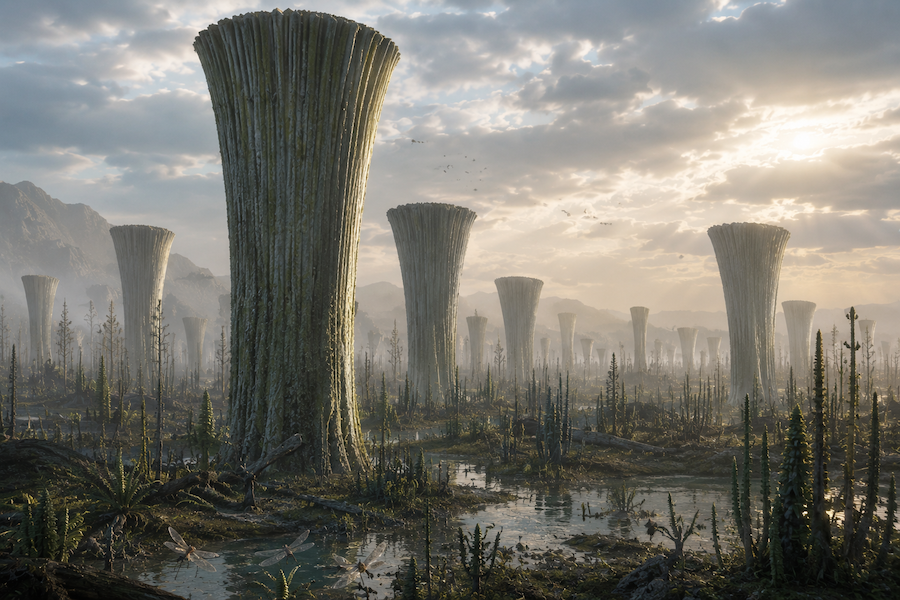
More than 400 million years ago, long before forests as we know them existed, something enormous was already towering over the landscape.
It was called Prototaxites, and some specimens reached around eight metres tall. At a time when most land plants were comparatively small, these strange column-like organisms would have been among the largest things standing on dry land.
The problem is that for more than 165 years, scientists haven’t been able to agree on what Prototaxites actually was.
Since its fossils were first described in the 19th century, researchers have variously proposed that it was a plant, an enormous alga, a lichen or, most persistently, some kind of gigantic fungus.
For years, the fungus explanation looked like the best answer.
Then scientists took another look.
Researchers studying exceptionally well-preserved 407-million-year-old Prototaxites taiti fossils from the Rhynie chert in Scotland compared their microscopic structure and chemical composition with fungi preserved alongside them.
They didn’t match.
The organism was structurally different from all known fungi, living or extinct. Its molecular fingerprint was also different, including an absence of the characteristic fossilisation products of chitin and chitosan that researchers would expect from fungal cell walls.
The results, published in Science Advances in January 2026, led the researchers to a remarkable possibility.
Prototaxites may belong to an entirely extinct lineage of complex life.
Not an eight-metre mushroom after all, but potentially something for which there is no living equivalent left on Earth.
That makes imagining the Devonian landscape rather different. You could have stood beside one of these enormous organisms, looked straight up at it and asked the perfectly reasonable question:
What is that?
More than 400 million years later, we’re still trying to answer it.
Ancient Egypt has left us pyramids, temples, statues and tombs built to survive eternity. But sometimes the smallest accidental mark can bring us closer to the people who actually made them.
Researchers at the Fitzwilliam Museum in Cambridge discovered a remarkably complete human handprint on the underside of a 4,000-year-old clay object known as a “soul house”. The object dates from around 2055–1650 BCE and was made for use in an Egyptian burial.
Soul houses were miniature clay buildings associated with tombs. This particular example has two storeys, pillars and staircases, along with tiny representations of food offerings including loaves of bread, a lettuce and an ox’s head. It may have served as an offering tray or symbolically provided a dwelling for the deceased.
But the handprint wasn’t part of the decoration.
The maker appears to have built the little house around a framework of wooden sticks, coated it with clay and shaped details by hand. Before the clay had dried, somebody picked it up, probably to move it out of the workshop before firing.
Their hand pressed into the underside.
Then the clay dried, the object went into the kiln, and that completely ordinary movement became permanent.
Fingerprints occasionally survive on ancient Egyptian objects, but Fitzwilliam senior Egyptologist Helen Strudwick said she had never seen such a complete handprint on an Egyptian object before.
We don’t know the name of the person who left it. We don’t know what they looked like, what they were thinking about that day or whether they even noticed the mark they had made.
And perhaps that’s why this one feels different.
Four thousand years later, we’re not looking at the work of a pharaoh or reading the carefully chosen words of someone important.
We’re looking at the moment an ordinary craftsperson picked up something they had just made and accidentally left a little piece of themselves behind.

For decades, visitors to a remote dry lakebed in Death Valley were confronted with a peculiar sight.
Heavy rocks sat scattered across the flat desert surface. Behind some of them stretched long, unmistakable trails carved through the mud.
The problem was simple.
Nobody had ever seen the rocks move.
At Racetrack Playa, stones ranging from small rocks to substantial boulders had apparently travelled across the ground, sometimes changing direction and leaving tracks extending for hundreds of metres. Scientists had been studying the phenomenon since at least the 1940s, proposing everything from powerful winds and slippery mud to ice.
But catching the rocks in the act was surprisingly difficult. They might remain completely still for years, even a decade or more.
Eventually researchers decided to wait them out.
They installed a weather station, time-lapse cameras and specially prepared rocks containing GPS equipment. The experiment began in 2011, and the scientists expected they might have to wait five or ten years before anything interesting happened.
Then, in December 2013, they happened to arrive at exactly the right moment.
The playa contained a shallow layer of water that had frozen overnight. As the morning sun warmed it, the ice began breaking into enormous but incredibly thin floating sheets, only a few millimetres thick. Light winds then pushed those sheets across the water.
And the ice pushed the rocks with it.
The movement wasn’t dramatic. Some stones travelled at only a few metres per minute, slow enough to be surprisingly difficult to notice. But during one event, researchers recorded more than 60 rocks moving, while GPS-equipped stones travelled as far as 224 metres over multiple events that winter.
After decades of mysterious tracks, elaborate theories and rocks that stubbornly refused to perform while anyone was watching, the answer turned out to require an unusually precise combination of ingredients:
A little water.
A freezing night.
A thin sheet of ice.
Some sunshine.
And a gentle breeze.
The rocks really were sailing across the desert. They were just doing it very, very slowly.
When a volcano erupts, you expect lava, ash, smoke, and rock.
You probably don’t expect it to produce long strands of golden hair.
Yet during certain eruptions in Hawaiʻi, fountains of extremely fluid basaltic lava can create something known as Pele’s hair, named after Pele, the Hawaiian goddess associated with volcanoes and fire.
And despite its delicate appearance, it isn’t hair at all.
It’s glass.
Pele’s hair forms when blobs of molten lava are pulled apart while still in the air. The liquid rock connecting them stretches into incredibly thin threads before cooling so quickly that it solidifies as volcanic glass. Individual strands can grow more than a metre long while remaining less than a millimetre thick. Some are vastly thinner still.
The result can look remarkably organic. The strands are typically golden-brown, light enough to be lifted into an eruption plume and carried considerable distances by the wind. They can drape themselves across vegetation, collect against rocks and kerbs, or become tangled together into strange volcanic tumbleweeds.
During eruptions at Kīlauea, Pele’s hair has been found many kilometres from the erupting vents. As recently as February 2026, long strands produced during lava fountaining at Kīlauea were carried southwest into the community of Pāhala, where they became tangled together as they blew around in the wind.
Beautiful though it looks, picking it up isn’t recommended.
The strands are extremely fragile. They can snap into tiny sharp fragments, producing glass splinters capable of irritating the skin and eyes. What looks like something soft enough to run through your fingers is actually freshly manufactured volcanic glass.
There is something wonderfully contradictory about Pele’s hair.
A volcanic eruption is one of the most violent processes on Earth.
Yet under exactly the right conditions, molten rock can be stretched so finely that the volcano appears to be spinning glass into golden thread.
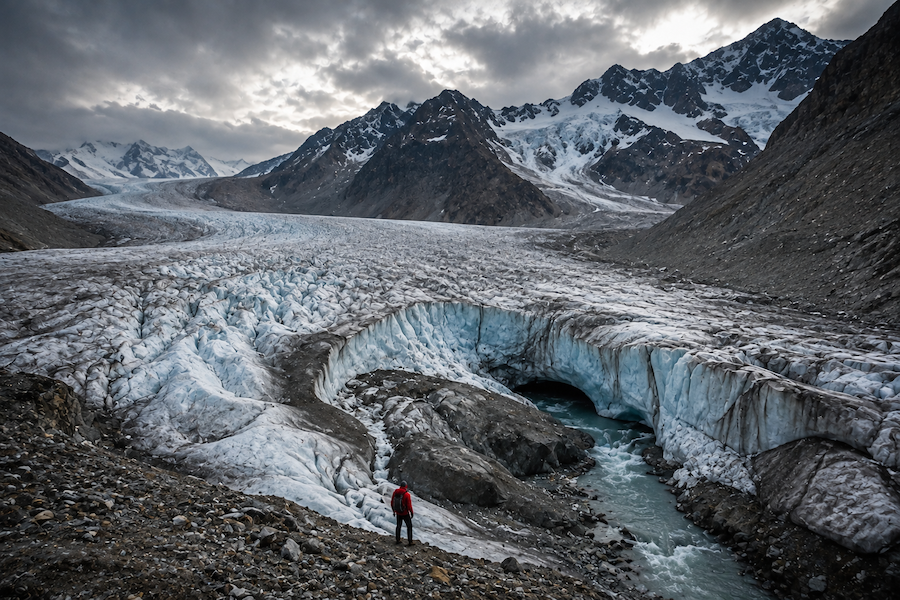
When someone disappears on a glacier, the place where they vanished may not be where they are eventually found.
Because a glacier isn’t simply a frozen landscape.
It moves.
Snow and ice accumulating high in the mountains slowly flow downhill under their own enormous weight. Anything buried deeply enough inside that ice can be carried with it, travelling through the glacier for decades before eventually reaching an area where melting exposes it again.
One remarkable Swiss case shows just how far that journey can be.
In March 1926, four young mountaineers disappeared during severe weather on the Great Aletsch Glacier. Searches found nothing. Then, in 2012, 86 years later, the remains of three brothers from the group appeared on the glacier’s surface.
Scientists subsequently used a computer model to reconstruct where the bodies had been.
The result was extraordinary.
During those 86 years, the three brothers had apparently travelled approximately 10.5 kilometres inside the glacier, descending around 800 metres in altitude. At one stage, their remains may have been buried roughly 250 metres beneath the surface.
The glacier had effectively become an extremely slow-moving conveyor belt.
And this isn’t an isolated phenomenon. Bodies, aircraft wreckage and belongings lost decades earlier continue to emerge from retreating Alpine glaciers. In 2026, for example, the remains of two Belgian mountaineers who disappeared in Switzerland in 1992 were identified after melting ice exposed them more than three decades later.
There is something unsettling about thinking of a glacier this way.
Someone can disappear into the ice and seemingly vanish from the world.
But beneath the surface, they may still be moving.
Metre by metre. Year after year. Until, decades later, the mountain gives them back.
We tend to imagine that the extraordinary must be hiding somewhere beyond the edges of what we know. Yet sometimes it is sitting beneath a microscope, buried inside a glacier, preserved in ancient clay or quietly waiting for somebody to point a telescope in the right direction.
And for everything we manage to explain, something else inevitably appears to remind us how much there still is to discover.
Some of the links on this site are Amazon affiliate links, which means I may earn a small commission if you make a purchase through them – at no extra cost to you. This helps support the blog and keeps the content coming. Thanks for your support!

Sue doesn’t just massage; she awakens your deepest desires. Her intuitive artistry reads your body’s unspoken needs, delivering customised pleasure that leaves you breathless and craving more.
Complete relaxation + targeted pleasure
Stress relief + sensual awakening
Slow, energy-building ecstasy
Spiritual + physical connection
Fantasy fulfilment
Personalised pleasure
Prostate + sacred masculine energy
Men seeking profound release
Deep feminine healing + orgasmic waves
Women embracing sensuality
Shared intimacy + guided exploration
Reigniting passion

🌶️ Sue’s After Dark Diaries Episode 47 Apparently, I Was Supposed to Look
The Bachelor Files Ep 14 The Morning I Should Have Gone Home
The Closure They Never Gave You | Reflections
Why We Want What We Can’t Have: The Psychology of Desire
🌶️ Sue’s After Dark Diaries Episode 46 The Holiday That Definitely Didn’t Go to Plan
🌶️ Sue’s After-Dark Diaries – Episode 45 Dan Does the Spin Cycle
Hey, my deliciously daring darlings… I can practically feel the secrets tingling between your toes. That midnight tiptoe across a hotel carpet, the sly brush of an ankle under the dinner table, the time your feet led you straight into trouble, and you loved every scandalous second.
Why hoard those toe-curling tales? Kick off your heels, wiggle free, and spill the juiciest, most wicked foot-fetish confessions you’ve got. I want the stories that make my pulse race, my cheeks flush, and my soles itch to join the fun.
Think you’ve got what it takes to make me squirm? Slide your steamiest secret into my inbox at [email protected] . Fair warning: I’m hard to shock… but a bold, barefooted confession? That just might do it.