Unexplained Historical Mysteries | Antiquities No. 4
Unexplained Historical Mysteries | Antiquities No. 4

You would think that after thousands of years of digging things up, mapping the planet and pointing increasingly expensive equipment at the sky, we would be running out of unexplained historical mysteries.
Apparently not.
There are enormous underground chambers in China that somebody carved out of solid rock, although nobody has managed to explain convincingly why they did it. There are streets and buildings sitting beneath modern cities, and nineteenth-century archaeological records containing measurements of human skeletons considerably taller than most people you’d expect to meet today.
Then there are the mysteries that refuse to stay conveniently in the past.
Scientists know that a major volcano erupted a little over two centuries ago because its chemical fingerprints are still trapped in ice. Finding the volcano itself has proved rather more difficult. Strange lights continue appearing over a Norwegian valley despite researchers turning up with cameras and scientific instruments to watch them.
And somewhere in all of this we have a radio telescope that once detected something unusual from space, millions of people remembering a cornucopia that apparently never existed, and chimpanzees doing something remarkably similar to treating one another’s wounds.
As usual, that doesn’t mean every extraordinary explanation attached to these stories is true.
It means the questions are real enough to be worth asking.
That’s what this fourth collection of Antiquities is about.
Not proving giants existed, deciding aliens sent us a radio message or declaring that history has been secretly rewritten. We’re doing something much more interesting than that.
We’re looking at what the evidence actually says, where the conventional explanations work, where they don’t quite answer everything, and — most importantly — where we simply don’t know yet.
Because sometimes the strangest part of a mystery isn’t what people claim happened.
It’s discovering how much of it really did.
The Giant Skeleton Reports Were Not Entirely Invented
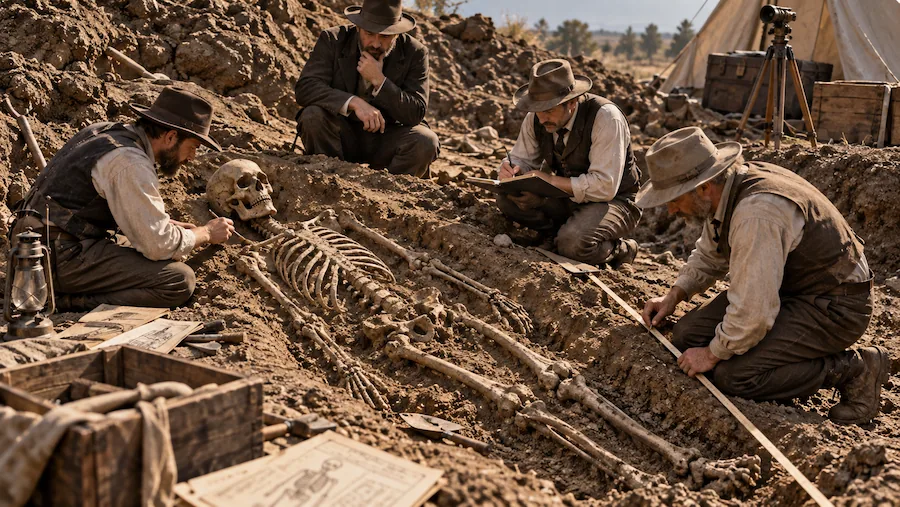
Stories about enormous human skeletons being excavated across nineteenth-century America are everywhere.
Depending on which version you encounter, the dead were eight feet tall. Nine feet. Ten feet. Occasionally considerably more.
Then comes the part many people will already have heard.
The Smithsonian supposedly arrived, collected the bones and transported them away. Somewhere along the way, the skeletons disappeared.
It’s an extraordinary story.
Unfortunately, much of the modern version is extremely difficult to substantiate.
But when you go back to the original records, something interesting happens.
The giant stories don’t disappear completely.
What the Records Actually Say
The Smithsonian Institution’s own nineteenth-century archaeological publications contain descriptions of unusually large human remains.
During investigations of burial mounds in Kanawha County, West Virginia, one skeleton was recorded as measuring 7 feet 6 inches in length, with a considerable distance between the shoulder sockets. Copper objects were also discovered with the burial.
Elsewhere, Smithsonian-associated archaeological records describe another individual as having been at least seven feet tall in life.
In Roane County, Tennessee, another set of remains was measured in the ground at approximately seven feet three inches from skull to toe. The investigator estimated that the person may have stood around seven and a half feet tall when alive.
Those aren’t modern internet stories.
They come from nineteenth-century archaeological records.
Newspaper reports went considerably further.
One 1880 discovery in Ohio produced reports of skeletons measuring somewhere around eight to nine feet. Other newspapers published increasingly spectacular accounts of enormous skulls, gigantic bones and individuals supposedly reaching heights well beyond anything recorded in modern humans.
This is where we need to be careful.
Nineteenth-century newspapers were perfectly capable of exaggeration. Stories were copied between publications, details changed during syndication and extraordinary discoveries sold papers.
One story appearing in ten newspapers does not necessarily mean ten discoveries took place.
There is another problem.
Measuring a fragile skeleton while it is still lying in disturbed earth isn’t remotely the same as reconstructing somebody’s height from intact long bones using modern forensic methods. Some of the archaeological reports themselves mention remains being extremely fragile.
So perhaps unusually tall individuals became the seed from which increasingly enormous newspaper giants grew.
Perhaps poor excavation produced exaggerated measurements.
Some reports may simply have been fabricated.
But none of that makes the Smithsonian’s genuine records disappear.
What we haven’t found is reliable primary evidence proving the popular claim that the Smithsonian systematically collected giant skeletons and subsequently hid, destroyed or lost crates containing them.
If such evidence exists, we’d want to see it.
For now, the race of ten-foot giants remains unproven.
The unusually tall skeletons recorded by nineteenth-century archaeologists?
Those really are in the records.
The Volcano That Erupted… Somewhere
Usually, when a volcano produces a major eruption, finding the volcano afterwards isn’t particularly difficult.
Mountains have a habit of remaining where we left them.
Unfortunately, one volcano appears not to have read the rules.
Scientists studying ice cores from Greenland and Antarctica discovered evidence of a substantial volcanic eruption around 1808–1809.
The chemical traces are still there.
Sulphur from the eruption reached the atmosphere, travelled around the planet and eventually became locked into layers of ice.
Something significant had happened.
But which volcano produced it?
Nobody has conclusively identified it.
Something Strange Appeared in the Sky
Historical accounts may provide another clue.
In Bogotá, Colombian scientist Francisco José de Caldas described an unusual atmospheric haze beginning in December 1808.
More than 2,500 kilometres away in Lima, Peruvian physician José Hipólito Unanue recorded extraordinary sunset afterglows during roughly the same period.
Those observations are consistent with volcanic material reaching high into the atmosphere.
So now we have two completely different kinds of evidence.
The ice remembers an eruption.
People living at the time appear to have seen its effects in the sky.
Yet the volcano responsible remains uncertain.
More recent research has even questioned whether scientists have been looking in the right part of the world. Different analyses have produced different possibilities for the eruption’s latitude and location.
There are candidates.
There are theories.
But there is no universally accepted culprit.
And that makes this a particularly lovely kind of mystery because we aren’t really asking whether something happened.
Nature has already answered that part.
A significant volcanic eruption occurred around the beginning of the nineteenth century and left evidence behind across the planet.
We simply haven’t found the mountain responsible.
Nature kept the receipt but appears to have misplaced the address.
Who Carved the Longyou Caves?
In 1992, villagers near Shiyanbei village in China’s Zhejiang Province decided to drain one of several unusually deep ponds.
For generations, the pools had simply been part of the landscape.
Then the water level began dropping.
Stone walls appeared.
And they kept going.
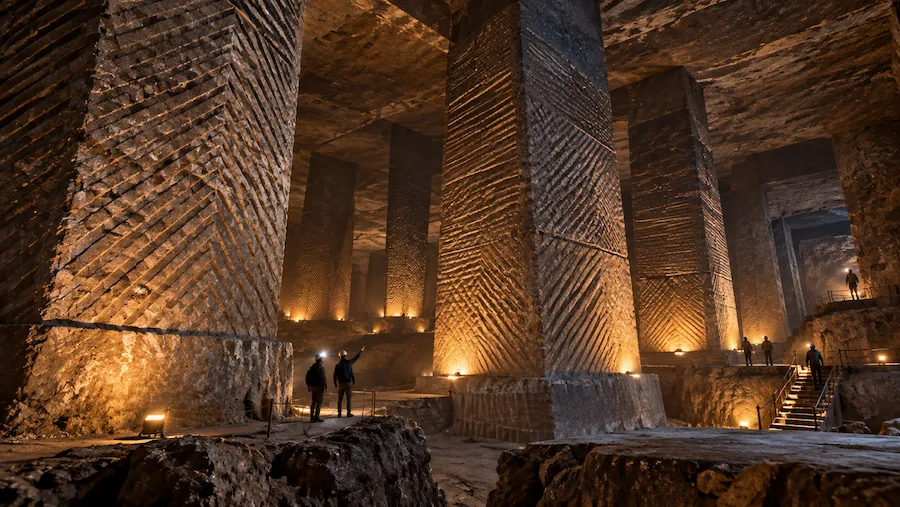
What eventually emerged was not a natural cave at all, but part of an enormous complex of artificial underground chambers now known as the Longyou Caves.
Around two dozen major caverns have been investigated, some reaching approximately 30 metres in height.
Inside are enormous pillars supporting vast stone ceilings.
Even more striking are the walls.
Repeated parallel chisel marks cover huge surfaces, running across walls, pillars and ceilings with remarkable consistency.
Someone unquestionably built this place.
The difficult part is explaining why.
Millions of Tonnes of Missing Rock
Creating the known chambers required the removal of an extraordinary quantity of stone.
Estimates place the excavated volume at around 900,000 cubic metres, potentially representing several million tonnes of rock.
That isn’t something a handful of people quietly accomplish during a spare weekend.
Workers had to quarry the chambers.
Someone had to organise them.
They required tools, lighting, food and some understanding of how to excavate enormous underground spaces without bringing the ceiling down on everybody involved.
Then there is another wonderfully simple question.
Where did all the rock go?
There have been numerous theories about the caves’ purpose.
Perhaps they were quarries.
Perhaps they were used for storage.
Military explanations have been proposed, along with ceremonial, burial and other possibilities.
The caves are clearly old, and pottery recovered from silt within them has been dated to ancient Chinese periods. Precisely when the chambers themselves were excavated, however, remains less certain.
What hasn’t emerged is a surviving historical account that neatly explains the entire project.
There is no need to introduce impossible technology or a vanished super-civilisation to make Longyou interesting.
Human beings carved these chambers.
That is extraordinary enough.
The mystery is why they undertook such an enormous project…
and why something so difficult to build left us with so little certainty about its purpose.
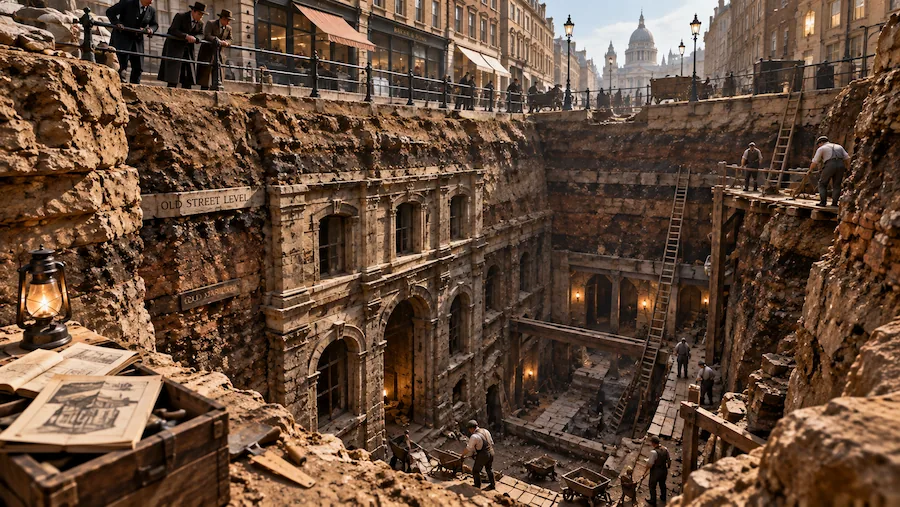
Why Are There Cities Beneath Our Cities?
This particular rabbit hole usually begins with photographs.
Windows disappearing beneath pavements.
Doorways apparently leading underground.
Excavations revealing older streets several metres below modern ones.
Occasionally, what looks suspiciously like an entire floor of a building is sitting beneath everybody’s feet.
And inevitably, the internet supplies an explanation.
The Mud Flood.
According to the more elaborate versions of the theory, a forgotten catastrophe buried cities across the world during the nineteenth century. Some versions connect this event with Tartaria, supposedly an advanced civilisation subsequently removed from accepted history.
It’s a spectacular proposition.
But before we get anywhere near that explanation, there is a much simpler question worth asking.
Why are so many old cities buried at all?
Because that part is real.
The World Beneath the Pavement
Central Moscow contains an enormous archaeological cultural layer.
Across much of the city it can reach several metres in thickness. In former natural depressions, accumulated deposits can become dramatically deeper.
St Petersburg also contains substantial layers of human-created material beneath its modern streets.
And Russia isn’t remotely unique.
Parts of old Chicago were deliberately raised during the nineteenth century to improve drainage.
After the devastating 1889 fire, streets in parts of Seattle were reconstructed at a higher level, leaving portions of the former city underneath.
Sacramento also raised streets and buildings following repeated flooding.
In many historic cities, today’s pavement simply isn’t where yesterday’s pavement used to be.
That can happen for dozens of reasons.
Flood protection.
Drainage.
Demolition rubble.
New construction.
Filled ravines.
Accumulating rubbish.
Regrading.
Buildings being raised.
Old structures being built over.
Centuries of people continually altering the landscape beneath their own feet.
So the photographs aren’t necessarily fake or misleading.
There really are cities underneath cities.
But Was There One Enormous Mud Flood?
This is where the physical evidence becomes important.
Archaeologists don’t generally find one enormous, uniform nineteenth-century layer sitting beneath every city.
Instead they find stratigraphy.
Different layers contain different materials from different periods: construction debris, pottery, industrial waste, buried soil, old roads, timber structures and successive phases of rebuilding.
Some cities absolutely have experienced catastrophic floods.
We know that because those events can leave distinctive deposits.
Kaifeng in China, for example, really was catastrophically buried following a seventeenth-century Yellow River flood. Archaeologists have found substantial flood deposits covering earlier structures.
So the basic idea that a flood can bury a city isn’t remotely ridiculous.
It happens.
What we haven’t found is convincing geological evidence for one forgotten nineteenth-century catastrophe that simultaneously buried cities across the world.
Could particular photographs still deserve investigation?
Certainly.
Could individual buildings have histories we haven’t properly reconstructed?
Of course.
But perhaps the most interesting discovery here doesn’t require a worldwide catastrophe at all.
Every major old city is a layer cake.
And underneath the streets we walk today are older streets, older buildings and older lives.
Which raises a slightly unsettling thought.
How much of the old world are we unknowingly walking above every day?
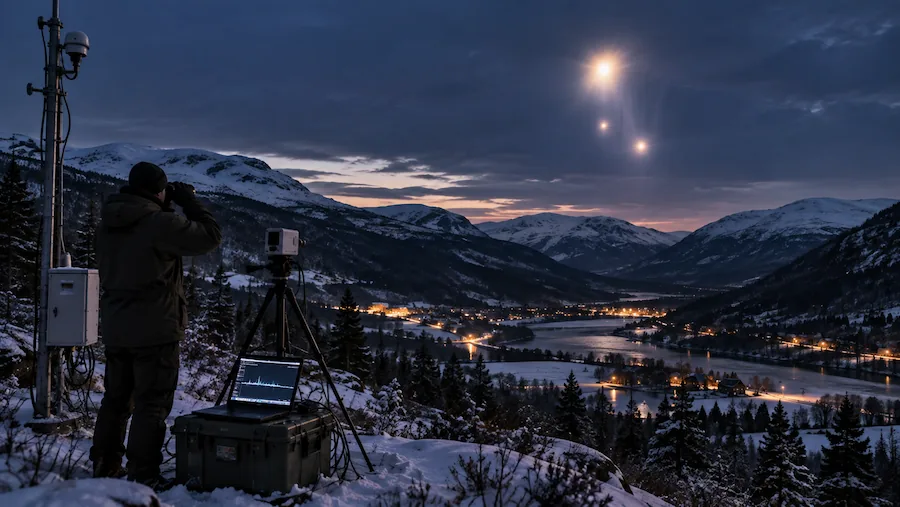
The Lights Scientists Keep Watching in Norway
There is a valley in central Norway where strange lights appear in the sky.
Normally, that sentence would be enough to send us wandering directly into UFO territory.
Except this time scientists brought equipment.
Cameras.
Radar.
Magnetometers.
Spectrum analysers.
And eventually geophysical surveying equipment.
The Hessdalen Lights became particularly famous during the early 1980s, when residents of the Hessdalen Valley reported frequent unexplained luminous phenomena.
In 1984, a dedicated observation campaign began.
And researchers saw them too.
So What Are They?
Descriptions vary.
Some lights appear white. Others have been reported as yellow or occasionally different colours.
Some remain visible for seconds.
Others persist considerably longer.
They may appear stationary or move through the valley.
Various explanations have been proposed over the years, ranging from atmospheric plasma to unusual electrical processes involving the local geology.
More recent research has investigated something particularly interesting beneath Hessdalen itself.
Geophysical surveys have identified conductive geological zones associated largely with mineral deposits.
Could the valley’s unusual geology somehow help create the lights?
Possibly.
But identifying an interesting geological feature isn’t the same as completely explaining the phenomenon.
There still isn’t one universally accepted mechanism accounting neatly for every reported Hessdalen event.
And perhaps that’s what makes the lights so interesting.
People saw something unusual.
Scientists arrived to investigate.
They deployed increasingly sophisticated equipment.
And instead of the mystery disappearing completely, it became a legitimate scientific question.
Maybe the eventual explanation will be entirely natural.
In fact, that seems perfectly plausible.
But natural doesn’t mean ordinary.
Sometimes discovering how something really works turns out to be considerably more interesting than the supernatural explanation.
The Cornucopia That Apparently Never Existed
Picture the Fruit of the Loom logo.
Don’t look it up.
Just picture it.
There is fruit.
An apple.
Grapes.
Leaves.
And behind them…
What do you see?
For a surprising number of people, the answer is immediate.
A cornucopia.
A curved horn-shaped basket sitting behind the fruit.
There is only one problem.
Fruit of the Loom says there has never been a cornucopia in its logo.
Surviving historical versions of the logo support the company’s position.
That ought to settle it.
Except this particular Mandela Effect has some rather stubborn loose ends.
The Residue
In 1973, Fruit of the Loom made a US trademark filing for a laundry detergent carrying its familiar fruit imagery.
Among the design classifications associated with the filing was a category covering:
“Baskets of fruit; Containers of fruit; Cornucopia (horn of plenty).”
That sounds spectacular until you look more closely.
The category appears to have been assigned as part of the trademark classification process. The actual submitted logo artwork doesn’t show a horn.
So that isn’t proof.
But 1973 gives us something else.
Jazz musician Frank Wess released an album called Flute of the Loom.
The artwork was clearly playing with Fruit of the Loom-style imagery.
There is a collection of fruit.
And behind it sits a flute shaped rather wonderfully like a cornucopia.
The album is real.
More importantly, it existed decades before the modern internet discussion surrounding the Fruit of the Loom Mandela Effect.
There are other historical references in which people appear to associate the brand’s fruit imagery with a cornucopia too.
None proves that the logo once contained one.
But they create an interesting question.
What Exactly Are We Remembering?
The conventional explanation is perfectly reasonable.
A pile of fruit is strongly associated with harvest imagery.
Cornucopias contain fruit.
Human memory doesn’t preserve a perfect photograph of everything we’ve ever seen. Our brains reconstruct images, sometimes adding details that seem as though they belong.
If enough people encounter similar imagery, perhaps enough people make the same reconstruction.
But there is another interpretation proposed by people who take the Mandela Effect more literally.
They describe these old references as residue — traces left behind after something about reality or history has somehow changed.
That idea creates an enormous scientific problem.
If the change supposedly affects old clothing, photographs, advertisements and physical objects retrospectively, then producing an old T-shirt without a cornucopia doesn’t disprove the theory.
The T-shirt, according to the hypothesis, would have changed too.
But that also makes the idea extremely difficult to test.
Evidence against it can always become evidence that the change was more complete than expected.
So we’re not going to tell you Fruit of the Loom definitely once had a cornucopia.
The available evidence doesn’t establish that.
But we are going to ask something slightly different.
Why were people associating Fruit of the Loom with a cornucopia before anybody had heard of the Mandela Effect?
Maybe the answer tells us something extraordinary about reality.
Maybe it tells us something extraordinary about memory.
Either way, there is something here worth understanding.
The Signal That Said “Wow!”
On 15 August 1977, the Big Ear radio telescope at Ohio State University detected something unusual.
It was strong.
It was narrow-band.
And it appeared to behave like a signal coming from a fixed position in the sky.
The telescope recorded its changing intensity as:
6EQUJ5
Those characters weren’t a secret message.
They represented the signal’s intensity.
When astronomer Jerry Ehman examined the computer printout afterwards, he circled the sequence and wrote one word beside it.
Wow!
The name stuck.
Then It Vanished
The signal lasted for approximately 72 seconds.
Its strength rose and fell in a way broadly consistent with the telescope’s beam passing across a fixed celestial radio source as the Earth rotated.
That made it particularly interesting.
Then came the frustrating part.
It disappeared.
Astronomers looked again.
And again.
The same signal has never been reliably detected returning from the same location.
Various explanations have been proposed over the decades.
Natural astronomical phenomena have been considered.
Terrestrial interference has been investigated.
More recent researchers have returned to archival observations searching for weaker signals that might help explain what Big Ear detected that night.
But the original Wow! Signal remains unresolved.
That doesn’t mean extraterrestrials contacted Earth in 1977.
Without a repeat detection, scientists cannot establish what produced it.
But it wasn’t invented by UFO enthusiasts either.
A radio telescope really recorded something unusual.
For just over a minute, something produced a strong narrow-band signal that caught the attention of an astronomer.
Then it stopped.
Perhaps one day we’ll discover exactly what it was.
Until then, we’re left with possibly the most scientifically appropriate reaction imaginable.
Wow.

Are Chimpanzees Practising Medicine?
Our final mystery doesn’t involve ancient ruins, buried cities or signals from space.
It begins with an injured chimpanzee.
Researchers studying the Rekambo chimpanzee community in Loango National Park, Gabon, noticed something unusual.
A chimpanzee called Suzee had a son with a wound on his foot.
She caught a tiny flying insect.
Then she appeared to manipulate the insect before applying it directly to her son’s injury.
That alone would have been interesting.
Then researchers saw similar behaviour again.
And again.
It Wasn’t Just Self-Care
A scientific study published in 2022 reported 19 observations of chimpanzees applying insects to their own wounds.
But there were also three occasions in which chimpanzees applied insects to wounds belonging to somebody else.
That’s where this becomes particularly intriguing.
Animals treating themselves with naturally occurring substances isn’t entirely new.
Different species have been observed consuming plants or other materials that may help with parasites and illness.
But deliberately applying something to another individual’s injury raises a different set of questions.
Do the chimpanzees understand that the other animal is hurt?
Do they believe the insect helps?
Have they learned the behaviour by watching others?
And most importantly:
Does the treatment actually work?
We don’t know yet.
Researchers haven’t established exactly which insects were being used in every case or whether they contain antibacterial, anti-inflammatory or pain-relieving compounds.
Nor can watching a chimpanzee tell us precisely what is happening inside its mind.
But the original observations haven’t simply vanished.
More recent research has documented related wound-care behaviour among other wild chimpanzees, adding to the possibility that forms of animal healthcare may be more sophisticated than we once assumed.
Perhaps the insects do nothing.
Perhaps the behaviour is social rather than medicinal.
Or perhaps somewhere in an African forest, chimpanzees discovered that putting a particular insect onto a wound helps long before any human researcher thought to ask them about it.
Which leads to a rather wonderful possibility.
We may not be looking at something uniquely human at all.
We might be looking at behaviour sitting somewhere near the distant evolutionary roots of an idea we eventually gave a name.
Medicine.
Sometimes the Evidence Is Where the Mystery Begins
There is a temptation with unexplained things to choose a side.
Either everything has a perfectly ordinary explanation and anyone asking questions is being foolish…
or every unanswered question must point towards something extraordinary being hidden from us.
Reality rarely behaves so conveniently.
The Smithsonian really did publish measurements of unusually tall human remains.
But that doesn’t prove a forgotten race of giants.
Cities really do have streets and buildings buried metres beneath their modern surfaces.
But that doesn’t prove a worldwide nineteenth-century mud flood.
A substantial volcano really did erupt around 1808 or 1809.
We still aren’t certain which one.
The Hessdalen Lights really have been studied using scientific instruments.
That doesn’t make them alien spacecraft.
People really were associating Fruit of the Loom with cornucopia imagery long before today’s Mandela Effect discussions.
That doesn’t tell us why.
The Wow! Signal really was detected.
We don’t know what produced it.
And chimpanzees really have been observed putting insects onto wounds.
We don’t yet know exactly what they understand about what they’re doing.
Perhaps that’s the part we sometimes forget.
“We don’t know” isn’t a failure.
It’s where almost every discovery begins.
There are things buried beneath our cities, preserved in forgotten records, frozen inside ancient ice and appearing unexpectedly through scientific instruments.
Some will eventually receive beautifully ordinary explanations.
Others may surprise us.
And a few might remain stubbornly unresolved for generations.
That’s why we’ll keep looking.
Not because every mystery proves something extraordinary.
But because sometimes the evidence itself is extraordinary enough.
And sometimes the evidence is where the questions begin.

Let yourself be carried away into the exciting world of sex swings. Give into the enchantment of the romance, passion, and deep sensuality that come with celebrating your love together. Surrender to the unique feeling of deep intimacy through shared peaks of passion.
Affiliate Disclosure:
Some of the links on this site are Amazon affiliate links, which means I may earn a small commission if you make a purchase through them – at no extra cost to you. This helps support the blog and keeps the content coming. Thanks for your support!
❤️ Experience Transcendent Pleasure with Sue:
Elite Sensual Massage Artistry

Step Into Your Private Paradise of Ecstasy
Picture this: you arrive at a discreet, luxurious sanctuary where the world fades away. Soft lighting and warm ambient music create instant calm. Every muscle tension melts under Sue’s expert, sensual touch – a premier sensual massage artist who transforms routine relaxation into unforgettable erotic journeys.
Sue doesn’t just massage; she awakens your deepest desires. Her intuitive artistry reads your body’s unspoken needs, delivering customised pleasure that leaves you breathless and craving more.
Experience – What You’ll Feel – Perfect For
Full Body Surrender –
Complete relaxation + targeted pleasure
Stress relief + sensual awakening
Tantric Ritual –
Slow, energy-building ecstasy
Spiritual + physical connection
Bespoke Erotic Massage –
Fantasy fulfilment
Personalised pleasure
Lingam Worship –
Prostate + sacred masculine energy
Men seeking profound release
Yoni Massage –
Deep feminine healing + orgasmic waves
Women embracing sensuality
Couples Sessions –
Shared intimacy + guided exploration
Reigniting passion
❤️ Ready to indulge? Call Sue on 07504 937253 or email [email protected] to book your private sensual massage today.

📇 Suggested Reading:
🌶️ Sue’s After Dark Diaries Episode 47 Apparently, I Was Supposed to Look
The Bachelor Files Ep 14 The Morning I Should Have Gone Home
The Closure They Never Gave You | Reflections
Why We Want What We Can’t Have: The Psychology of Desire
🌶️ Sue’s After Dark Diaries Episode 46 The Holiday That Definitely Didn’t Go to Plan
🌶️ Sue’s After-Dark Diaries – Episode 45 Dan Does the Spin Cycle
📧 Drop Me a Line, You Naughty Wanderers…
Hey, my deliciously daring darlings… I can practically feel the secrets tingling between your toes. That midnight tiptoe across a hotel carpet, the sly brush of an ankle under the dinner table, the time your feet led you straight into trouble, and you loved every scandalous second.
Why hoard those toe-curling tales? Kick off your heels, wiggle free, and spill the juiciest, most wicked foot-fetish confessions you’ve got. I want the stories that make my pulse race, my cheeks flush, and my soles itch to join the fun.
Think you’ve got what it takes to make me squirm? Slide your steamiest secret into my inbox at [email protected] . Fair warning: I’m hard to shock… but a bold, barefooted confession? That just might do it.