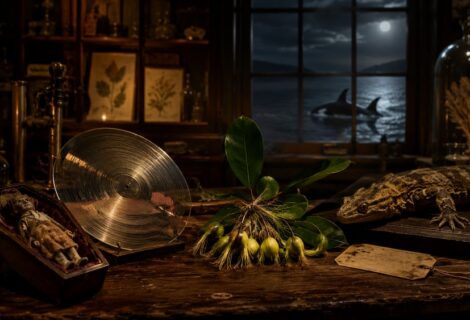
After Dark Diaries | Antiquities No. 1

There are facts that are surprising, facts that are strange, and then there are those that make you stop halfway through a sentence and wonder whether somebody is having you on.
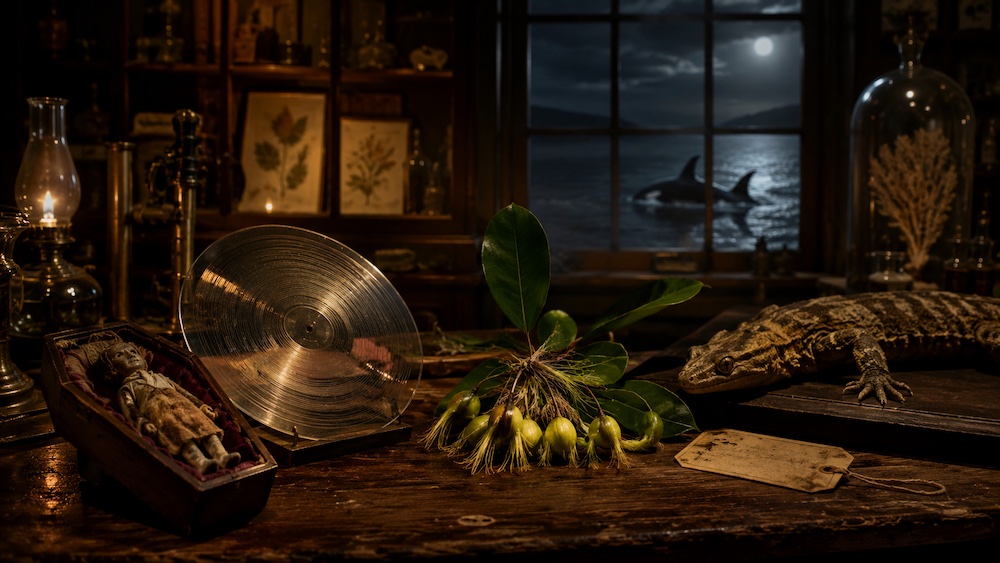
Hidden coffins containing tiny dressed figures. Scientific specimens that aren’t actually alive. Animals doing things we only recently realised they could do. Voices recovered from objects that were never meant to be played again. Creatures remembered in stories before science caught up with them.
The world has an irritating habit of being considerably stranger than anything we could invent.
Everything in this collection has one thing in common: there is evidence behind the story. Where scientists don’t know the answer, we’ll tell you they don’t know. Where something is only a theory, we’ll call it a theory.
Because sometimes “we still have absolutely no idea” is far more interesting than pretending that we do.
In June 1836, a group of boys went rabbit hunting on Arthur’s Seat, the ancient volcanic hill overlooking Edinburgh.
Instead of rabbits, they found a small cave.
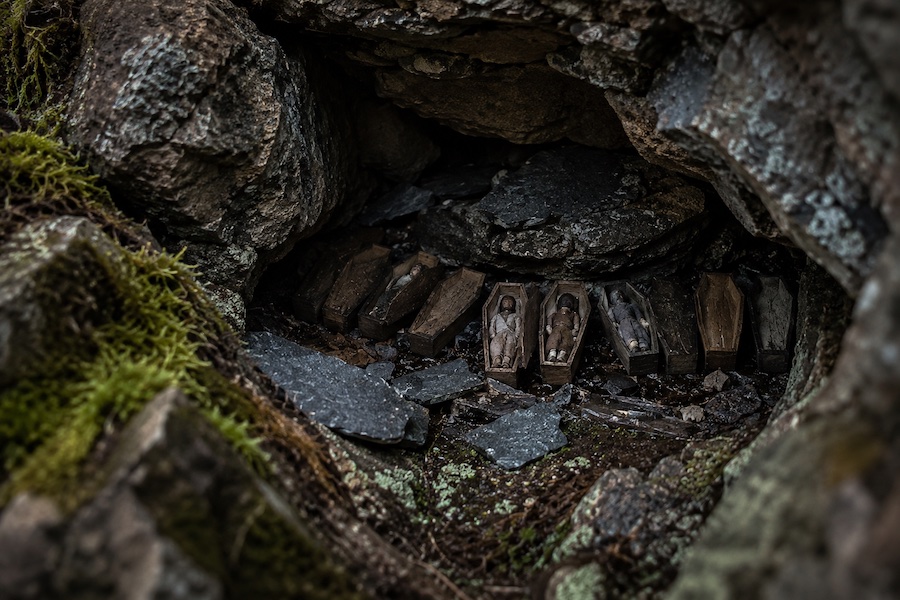
Hidden inside, behind three pointed pieces of slate, were 17 miniature wooden coffins.
They weren’t scattered randomly. The coffins had been carefully arranged in three tiers: two rows of eight, with a single coffin above them.
And somebody had gone to an extraordinary amount of trouble.
Each coffin measured only around 95 millimetres long and contained a tiny carved wooden figure. The figures had been dressed in miniature clothes that had been stitched and glued around their bodies. Some appeared to have originally been toy soldiers, with arms possibly removed simply so they would fit inside their tiny graves.
Naturally, 19th-century Edinburgh had theories.
Witchcraft was suggested almost immediately. Another explanation involved an old custom of symbolically burying people who had died far from home. Later came theories involving sailors’ charms.
Then somebody noticed an uncomfortable coincidence.
There were 17 coffins.
And Burke and Hare, the notorious Edinburgh murderers who supplied bodies for anatomical dissection, were associated with 17 victims.
Could somebody have created the miniature coffins to provide symbolic burials for people whose bodies had instead ended up on an anatomist’s table?
Possibly.
But there is no proof.
Later examination established that the figures appear to have been made by one person, while the coffins themselves may have involved two makers. The clothing dates from the early 1830s, meaning the little collection hadn’t been hidden for very long before the boys stumbled across it.
Of the original 17, only eight survive today.
They’re kept by the National Museum of Scotland, where nearly two centuries after their discovery, the most obvious questions remain unanswered.
Who made them?
Who were they supposed to represent?
And why did somebody carefully dress 17 tiny wooden people, place each one inside its own handmade coffin, arrange them beneath pieces of slate…
…and walk away?
Nobody knows.
In 1952, a peculiar specimen arrived at Kew from Lancashire.
At first glance, it looked remarkably like some kind of puffball fungus. It was round, damaged and sufficiently convincing to find its way into Kew’s enormous Fungarium collection.
There was only one slight problem.
It was a burnt golf ball.
The scorching had exposed rubber strands inside the ball in a way that made it resemble the internal structure of an earthball fungus.
Somebody even attempted a conventional fungal test, leaving the supposed specimen on paper overnight to see whether it deposited spores.
It didn’t.
Which, considering it had presumably spent the earlier part of its existence being hit around a golf course, wasn’t terribly surprising.
A decade later, things became even more ridiculous when another burnt golf ball arrived, this time from East Africa. Kew’s then Head of Mycology, R. W. G. Dennis, decided to take the joke considerably further.
In 1962 he formally described the peculiar new “fungus” and gave it a magnificent scientific name:
Golfballia ambusta.
Which essentially means burnt golf ball.
Dennis left clues throughout his description that he knew exactly what he was doing, including references to small elastic spheres enjoyed by the Caledonians in certain tribal rituals.
Golf. Scotland. You get the idea.
Then, in 1971, yet another specimen arrived from Kent.
Kew still retains the Golfballia specimens today. The institution describes the episode as one of the great hoaxes in the history of its Fungarium — and people encountering the scientific name in databases can apparently still mistake it for a genuine fungus.
So, strictly speaking, scientists didn’t spend decades completely unaware that they’d classified sporting equipment as a living organism.
The truth is better.
They realised it was a golf ball and gave it a Latin name anyway.
If somebody told you they’d discovered an 18-metre tree whose fruit grows on the ground and tastes of banana, guava and eucalyptus, you might reasonably assume they’d been sampling something other than the fruit.
But in 2025, botanists formally described exactly such a tree.
It’s called Eugenia venteri, and so far it is known from Manus Island in Papua New Guinea.
The really peculiar part isn’t what happens at the top of the tree.
It’s what comes down from it.
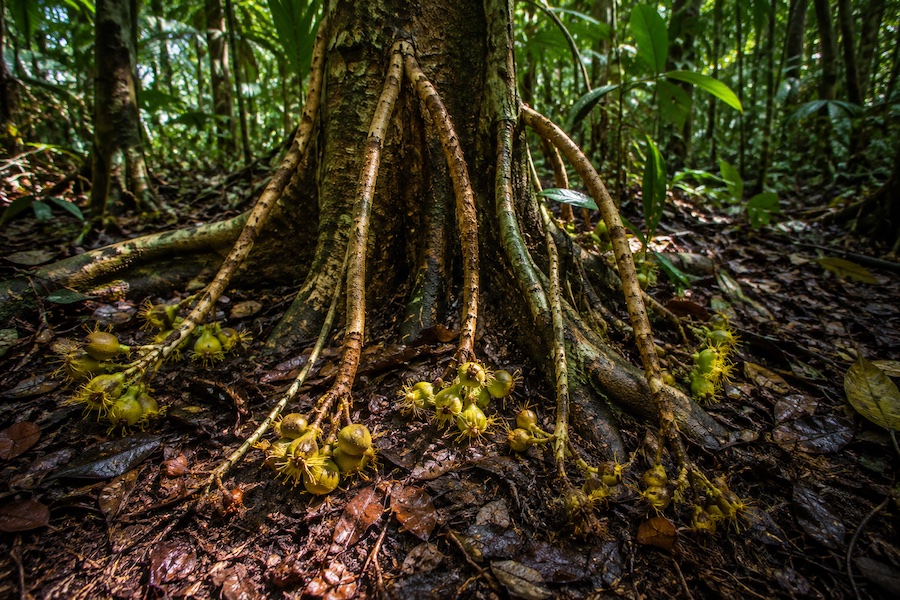
Long, thin, whip-like stems emerge from the main trunk, some beginning around five metres above the ground. They cascade down the tree, reach the forest floor and then continue travelling through or just beneath the leaf litter.
Some extend as far as seven metres away from the trunk.
And that’s where the tree produces its flowers and fruit.
So rather than climbing an 18-metre tree to pick something from its canopy, you could theoretically find its fruit sitting amongst the leaves on the forest floor several metres away.
The fruit itself is roughly four to five centimetres across and ripens from green to yellow.
Then somebody tasted it.
Collectors described the flavour as a mixture of guava and banana, followed by an eucalyptus-like aftertaste.
Researchers suspect that putting its flowers and fruit at ground level allows the tree to attract visitors that don’t fly. Native rats and bandicoots are among the possible pollinators or seed dispersers, and ripe fruit has even been found bearing what appear to be rodent bite marks. For now, exactly which animals are visiting the tree, and what they’re doing when they get there, remains another part of the mystery.
Which leaves us with an 18-metre rainforest tree that sends its reproductive branches down its own trunk and across the ground…
…possibly because that’s where the customers are.
And apparently, it serves banana, guava and eucalyptus.
Look at one of your hands.
Count the fingers.
Five.
You’d imagine that, of all the things your brain might become confused about, how many fingers are attached to your own hand would be fairly difficult to get wrong.
Apparently not.
Scientists studying something known as the sixth-finger illusion have demonstrated that the human brain can be persuaded to experience an additional finger that simply isn’t there.
The illusion builds on a peculiar weakness in the way our brains decide what belongs to our bodies.
We tend to think bodily ownership is straightforward: your hand feels like your hand because, well, it’s attached to you.
But the brain is actually combining information from sight, touch and the position of your limbs to continuously construct that feeling of this is me.
And those signals can be manipulated.
In a 2025 study involving 80 people, researchers used carefully coordinated touch around the outside of the hand to create the sensation of an extra finger. Some participants could see a rubber sixth finger beside their real hand. Others saw nothing at all — just empty space where the additional finger should have been.
And yet the illusion still worked.
Stroking the outer edge of the palm could produce the sensation of possessing an additional, independent finger. In some conditions, that feeling even became stronger when the experiment was repeated. Previous research has suggested something stranger still: the imaginary finger can feel as though it has characteristics of its own, rather than simply being a phantom copy of the little finger.
There is a serious purpose behind all this oddness. Scientists are interested in what these illusions could teach us about prosthetics, rehabilitation and even wearable robotic extra fingers.
But there’s also something wonderfully unsettling about it.
You probably feel completely certain about where your body ends.
Your brain, however, appears to be rather more open to negotiation.
Give it the right combination of sensations, and it may simply decide:
Actually, six fingers seems perfectly reasonable.
When mammalogist Tyrone Lavery arrived on the island of Vangunu in the Solomon Islands in 2010, local people told him about a rat.
Not an ordinary rat.
They described an enormous tree-dwelling animal called the vika, said to live high in the rainforest canopy and capable of gnawing into coconuts.
The animal wasn’t some newly invented rumour. Traditional knowledge of the vika had been documented years earlier, and scientists visiting Vangunu in the 1990s had also heard about it.
There was just one frustrating problem.
Lavery couldn’t find one.
He searched.
He set traps.
He used cameras.
He looked for years.
At one point, he began wondering whether the vika really was a separate species at all.
Then, in 2015, the forest provided the answer in a rather brutal way.
A tree was felled during logging and an enormous rat came out of it. The animal was badly injured and died, but local people immediately recognised it as the vika they’d been describing.
When scientists examined the animal, its skull and DNA confirmed something remarkable.
It really was a species previously undescribed by science.
It was eventually named Uromys vika, using the local name people had been calling it all along.
And it really is enormous by rat standards.
Vangunu giant rats can weigh up to around a kilogram, several times the weight of the familiar black rats found across much of the world. They live in trees, which helps explain why conventional searches on the forest floor had been so unsuccessful.
As for those coconut-cracking stories, that part remains a little less certain.
Local knowledge describes vika eating coconuts, but researchers haven’t directly documented the behaviour scientifically. They have, however, found nuts bearing the distinctive circular gnaw marks associated with the animal.
Unfortunately, the story has another twist.
The vika lives only on Vangunu, and its remaining primary forest habitat is under severe pressure from logging. For several years after the first specimen, scientists didn’t even know whether the species still survived.
This time, researchers turned to the people who knew the animal best.
Using camera traps positioned with the help of Vangunu traditional ecological knowledge, researchers obtained 95 photographs in 2022, apparently showing four individuals alive in the Zaira forest.
So perhaps this isn’t really a story about scientists discovering a giant rat.
It’s a story about science finally documenting something the people living beside it had been telling them was there all along.
In a laboratory in Washington, D.C., on 17 November 1884, somebody said one extremely ordinary word.
Barometer.
Nothing remarkable about that.
Except the voice was being recorded onto a glass disc using light.
The experiment took place at the Volta Laboratory, where Alexander Graham Bell, his cousin Chichester Bell and inventor Charles Sumner Tainter were experimenting with different ways of capturing and reproducing sound.
At the time, recorded sound was still astonishingly new.
Thomas Edison had demonstrated his phonograph only a few years earlier, and inventors were trying all sorts of methods and materials to work out how sound might best be preserved.
Wax.
Rubber.
Foil.
Metal.
Glass.
And, in this particular experiment, photography.
The Volta researchers devised a process in which sound vibrations affected a beam of light, which in turn exposed a prepared photographic surface. On the surviving glass disc, the sound became a spiral pattern whose width changed according to the characteristics of the voice.
It was extraordinarily clever.
Unfortunately, preserving a voice on fragile glass created a rather obvious problem for anyone hoping to hear it again.
The experimental recordings eventually entered the Smithsonian’s collections, where many remained effectively silent. They were too fragile and unusual to risk playing using conventional physical methods.
Then technology caught up with them.
In 2011, researchers from the Smithsonian, Library of Congress and Lawrence Berkeley National Laboratory used a non-contact technique to create high-resolution digital scans of the old recordings.
Instead of dragging a stylus across the fragile surface, computers could analyse the physical pattern and reconstruct the sound encoded within it.
And suddenly, after approximately 127 years, the glass spoke.
The recording lasts only around seven seconds. The identity of the speaker isn’t certain, although the Smithsonian says it may have been a man named Henry Gustave Rogers.
No profound message had been waiting for us.
No lost speech from Alexander Graham Bell.
No prediction of the technological world to come.
Just a male voice carefully sounding out the same wonderfully mundane word several times.
A Victorian experiment with light.
A fragile sheet of glass.
A voice nobody had heard for more than a century.
And one word waiting inside it.
Barometer.
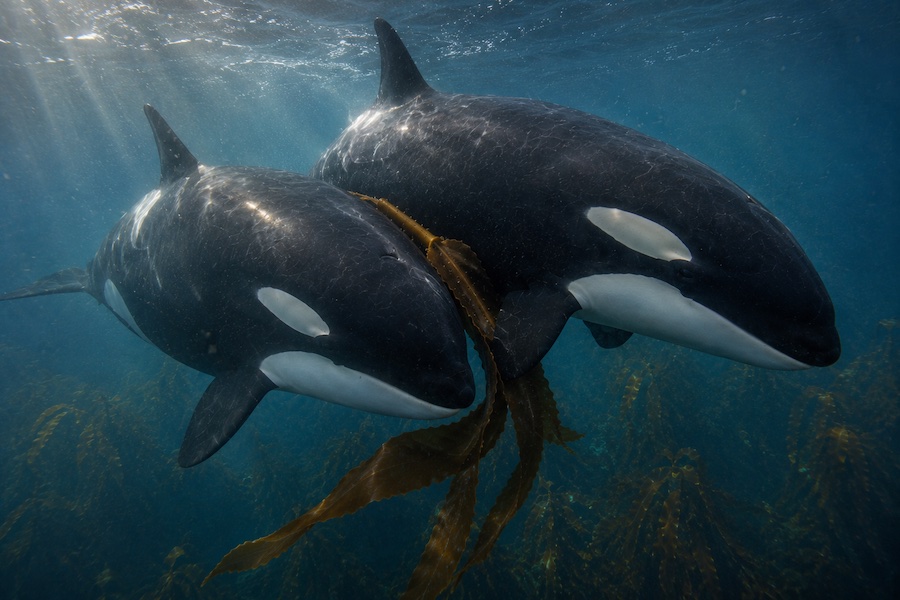
Killer whales using kelp isn’t particularly new.
They’ve been seen playing with it and draping it over themselves before.
But when researchers flew drones over southern resident killer whales in the Salish Sea in 2024, they noticed the whales doing something considerably more sophisticated.
They were making things with it.
A whale would take a stalk of bull kelp and detach a shorter section. It would then position that piece of kelp between its own body and the body of another whale.
The pair would press together and move so that the kelp rolled between them.
In other words, they appeared to be using a homemade kelp grooming tool on each other.
Researchers call the behaviour allokelping.
And this wasn’t simply one unusually inventive whale having an afternoon experiment.
The behaviour was widespread among the southern resident population the researchers observed. Whales with more visible skin shedding appeared to participate more frequently, suggesting grooming may indeed be one of its functions. But there was also a distinctly social element: whales tended to allokelp with close relatives and animals of similar age.
That makes the discovery particularly interesting. Tool use in animals is nothing new, and killer whales are already famous for remarkably sophisticated behaviour. But researchers believe this may be the first documented example of a wild animal using a tool in a way that benefits two individuals at the same time.
There’s another unusual detail too. The whales aren’t holding the kelp in a beak, hand, paw or trunk. They’re manipulating it largely with their bodies, something researchers say may also be unique among known examples of animal tool use.
And we might never have noticed it from a boat.
It was detailed overhead drone footage that allowed researchers to see exactly what was happening between the whales’ bodies.
So these enormous, intensely studied animals may have been cutting pieces of seaweed and rolling them over one another for years…
…while we floated around above them completely oblivious.
And that raises a rather lovely question.
What else are animals doing that we simply haven’t learned how to see yet?
For generations, Māori accounts from New Zealand referred to an enormous forest lizard known as the kawekaweau.
Historical accounts vary, but some describe a very large lizard unlike anything known to be living in New Zealand today.
Then, thousands of miles away, something extraordinary turned up in a French museum.
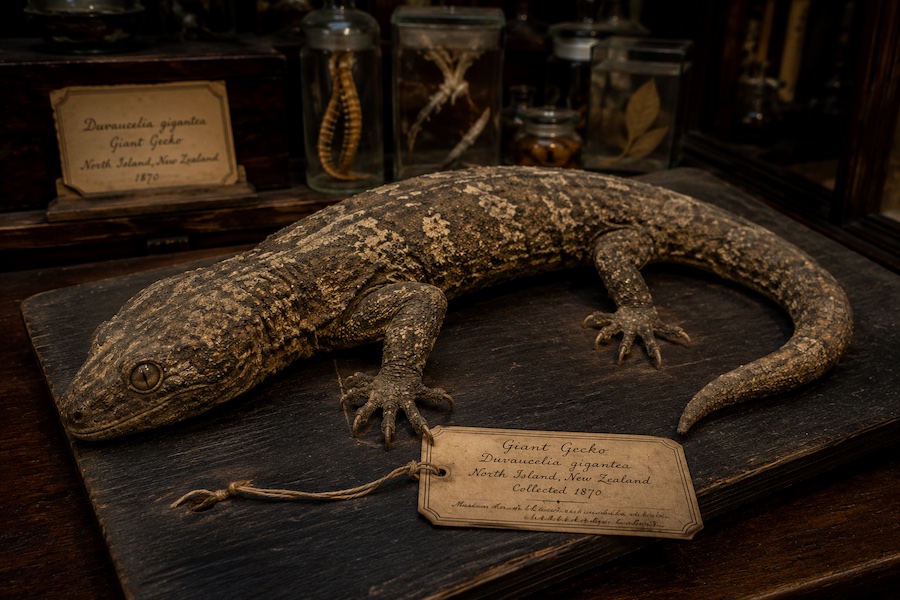
Sitting in the collections of the Natural History Museum in Marseille was an enormous stuffed gecko.
Nobody knew exactly where it had come from.
Nobody knew when it had been collected.
It had probably been in the museum since at least the 19th century.
And it was huge.
The specimen measures about 37 centimetres from snout to vent, roughly 50% longer than the next-largest known gecko species. With its tail included, the living animal would have been substantially longer still.
In the 1980s, scientists formally described it as a new species.
They called it Hoplodactylus delcourti.
Before long, an irresistible possibility emerged.
Its enormous size and appearance seemed remarkably consistent with historical Māori descriptions of the kawekaweau. Anatomical features also appeared to place it alongside New Zealand geckos.
Could this forgotten museum specimen be physical evidence that the supposedly legendary giant lizard had actually existed?
For years, the possibility was taken seriously. A 1987 paper even argued that folklore and the physical specimen together supported identifying the animal with the kawekaweau.
There was, however, a problem.
Nobody could prove where the museum specimen came from.
Researchers searched for supporting evidence. They examined its stuffing. They looked at pollen associated with it. They searched New Zealand’s fossil and subfossil record.
Nothing conclusively tied the animal to New Zealand.
For decades, one obvious solution remained tantalisingly out of reach:
ask the gecko itself.
Early attempts to extract usable DNA failed.
Then technology improved.
In 2023, researchers successfully recovered genetic material from a tiny sample of bone taken from the unique specimen.
After more than a century sitting anonymously in a French museum, the giant gecko finally gave scientists an answer.
And it wasn’t the answer many had expected.
The DNA showed that the animal wasn’t particularly closely related to New Zealand’s living geckos at all.
Its closest living relatives belonged to a lineage from New Caledonia, more than 1,500 kilometres away. The differences were significant enough that scientists moved it into an entirely new genus:
Gigarcanum delcourti.
And the name is rather wonderful.
Gigarcanum combines ideas of giant and mystery.
The connection to the Māori kawekaweau hasn’t been rendered logically impossible; the researchers themselves note the historical description, but the genetic evidence has seriously weakened the once-popular idea that the French specimen proves the New Zealand stories described this particular species. There is also still no fossil evidence placing Gigarcanum in New Zealand.
So we finish not with the satisfying story we might have wanted:
“The mythical monster was real.”
We finish with something better.
For decades, scientists had an enormous dead gecko, no collection records, an intriguing piece of traditional knowledge and a very plausible theory connecting them.
Then DNA arrived…
…and told them the story was probably more complicated.
We now know what family the mysterious giant belonged to.
We know that it was unlike any gecko alive today in size.
We know that somebody collected the only known specimen, probably during the 19th century, and somehow it eventually ended up in Marseille.
But we still don’t know where they found it.
We don’t know exactly when it disappeared.
And we still don’t know exactly what animal lay behind the old accounts of the kawekaweau.
After more than a century in a museum…
the world’s largest known gecko has managed to keep its biggest secret.

Some of the links on this site are Amazon affiliate links, which means I may earn a small commission if you make a purchase through them – at no extra cost to you. This helps support the blog and keeps the content coming. Thanks for your support!

Sue doesn’t just massage; she awakens your deepest desires. Her intuitive artistry reads your body’s unspoken needs, delivering customised pleasure that leaves you breathless and craving more.
Complete relaxation + targeted pleasure
Stress relief + sensual awakening
Slow, energy-building ecstasy
Spiritual + physical connection
Fantasy fulfilment
Personalised pleasure
Prostate + sacred masculine energy
Men seeking profound release
Deep feminine healing + orgasmic waves
Women embracing sensuality
Shared intimacy + guided exploration
Reigniting passion

🌶️ Sue’s After Dark Diaries Episode 47 Apparently, I Was Supposed to Look
The Bachelor Files Ep 14 The Morning I Should Have Gone Home
The Closure They Never Gave You | Reflections
Why We Want What We Can’t Have: The Psychology of Desire
🌶️ Sue’s After Dark Diaries Episode 46 The Holiday That Definitely Didn’t Go to Plan
🌶️ Sue’s After-Dark Diaries – Episode 45 Dan Does the Spin Cycle
Hey, my deliciously daring darlings… I can practically feel the secrets tingling between your toes. That midnight tiptoe across a hotel carpet, the sly brush of an ankle under the dinner table, the time your feet led you straight into trouble, and you loved every scandalous second.
Why hoard those toe-curling tales? Kick off your heels, wiggle free, and spill the juiciest, most wicked foot-fetish confessions you’ve got. I want the stories that make my pulse race, my cheeks flush, and my soles itch to join the fun.
Think you’ve got what it takes to make me squirm? Slide your steamiest secret into my inbox at [email protected] . Fair warning: I’m hard to shock… but a bold, barefooted confession? That just might do it.