Down Below
ARTICLE | MASSAGE & WELLNESS | DOWN BELOW

Ladies, Let’s Talk About Your Pelvic Floor (And Your Pleasure!)
Ladies, can we have a little chat about something that doesn’t always come up over coffee with the girls?
Our pelvic floor.
Yes, those muscles down below that we rarely give a second thought to until something starts feeling a little different!
Now, I know some women can talk quite happily about almost anything, while others would rather hide behind the sofa than discuss their most intimate bits.
But why should we be embarrassed?
We talk about looking after our skin, our hair, our weight and everything else. Yet there’s one rather important part of our bodies that often gets forgotten.
And believe me, ladies, it deserves a little attention too!
Whether you’ve had children, noticed changes as you’ve got older or simply want to understand your body better, your pelvic floor is worth knowing about.
And no, this isn’t just about improving your sex life, although I suspect that little detail might have caught your attention!

When Things Don’t Feel Quite the Same
Have you ever noticed that something which once felt wonderful doesn’t seem to produce quite the same sensation anymore?
Perhaps intimacy feels different after having children. Maybe you’ve noticed changes during menopause, or you’ve simply found that your body doesn’t respond in quite the way it used to.
It can leave you wondering what’s going on.
And if you’re anything like me, you’ll probably have a hundred questions running through your head before you’ve even finished your morning coffee!
Is this normal? Is it my age? Can I do anything about it?
The truth is, ladies, our bodies change throughout our lives.
Pregnancy, childbirth, hormonal changes, menopause and certain health conditions can all affect how we experience intimacy.
Sometimes pelvic floor weakness plays a part, but it isn’t always the explanation.
Changes in lubrication, comfort, arousal and sensitivity can also make a difference.
So please don’t automatically assume that your vagina has somehow become too loose or that there’s something wrong with you.
And definitely don’t let somebody else’s comments convince you that your body isn’t good enough.
Honestly, we women have enough to worry about without adding that to the list!
If something has changed and it’s bothering you, there’s nothing embarrassing about asking a healthcare professional for advice.
You deserve to feel comfortable and confident in your own body.
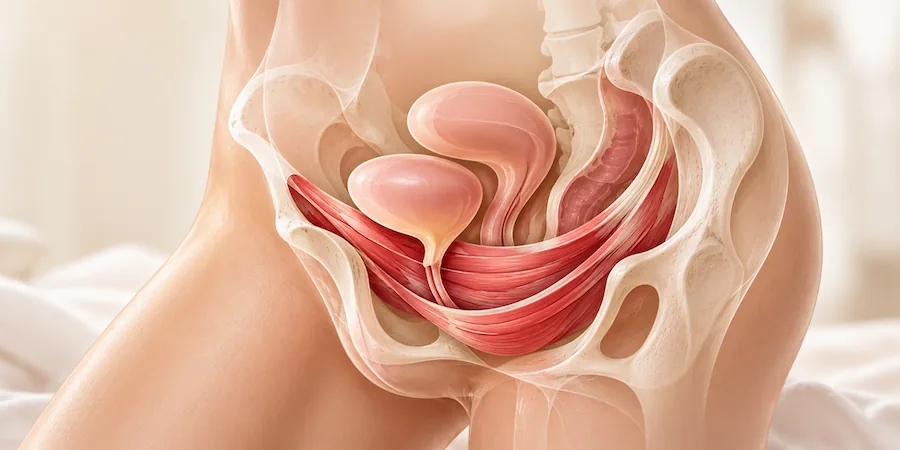
What Your Pelvic Floor Actually Does
Now, here’s where we get a little educational.
Don’t worry, I promise there won’t be an examination afterwards!
Your pelvic floor is a group of muscles stretching across the bottom of your pelvis, rather like a supportive hammock.
These muscles help support your bladder, bowel and uterus. They also play an important role in bladder and bowel control, and they’re involved in sexual function.
Quite a busy little group of muscles, aren’t they?
And to think most of us barely acknowledge them!
Like other muscles, the pelvic floor can become weaker or less effective for various reasons, including pregnancy, childbirth, ageing and certain medical conditions.
Some women might notice a little urine leakage when they cough, laugh or sneeze.
Oh, the joys!
Others may experience a feeling of heaviness or notice changes during intimacy.
But here’s something important.
Not every pelvic floor problem is caused by weak muscles.
Sometimes the muscles are too tense or have difficulty relaxing properly. That can contribute to discomfort, pain during sex or problems with bladder and bowel function.
And when it comes to sexual pleasure, there’s more to the story than muscle strength alone.
Our pelvic floor muscles are involved in the body’s response to sexual stimulation, including the contractions that can happen during orgasm.
For some women, improving pelvic floor muscle function may help with sexual sensation, confidence and satisfaction.
But stronger muscles don’t automatically guarantee stronger orgasms.
I wish everything were that simple!
Our hormones, physical comfort, emotional wellbeing, relationship and level of arousal all have a part to play.
Let’s face it, if you’ve spent the entire day rushing around, worrying about everything and everybody, sometimes the last thing on your mind is getting romantic!
And that’s perfectly normal.
The important thing is understanding how your own body works, rather than comparing yourself with how things felt twenty years ago.

A Little Exercise Can Go a Long Way
Right then, ladies, shall we talk about giving those muscles a little workout?
The good news is that pelvic floor exercises don’t require a gym membership, expensive equipment or a pair of Lycra leggings!
You can usually practise them while sitting, standing or lying down.
And nobody needs to know what you’re doing.
Although I wouldn’t recommend announcing it halfway through a conversation!
The idea is to gently squeeze and lift the muscles around your back passage and vagina, as though you’re trying to stop yourself passing wind and holding in urine at the same time.
You should feel an inward and upward movement.
Try not to hold your breath, clench your bottom or squeeze your thighs together.
And remember to relax the muscles completely afterwards.
That last part is just as important as the squeeze itself.
NHS guidance generally recommends practising a mixture of longer holds and quick contractions, gradually building up according to what you can comfortably manage.
For example, you might begin by holding a gentle contraction for a few seconds, relaxing fully, and repeating it several times. You can also practise shorter, quicker squeezes.
Over time, you can gradually work towards holding each contraction for up to ten seconds, alongside shorter, quicker squeezes. NHS guidance recommends a mixture of both, while NICE advises at least eight contractions three times a day for women following a pelvic floor training programme for urinary incontinence. The important thing is to work at your own pace, relax properly between each squeeze and get professional advice if you’re unsure.
But don’t worry if you can’t manage that straight away.
We’re exercising muscles, not entering the Olympics!
And please don’t regularly practise by stopping your urine halfway through going to the toilet. Although you may have heard that advice years ago, it’s not recommended as an exercise because it can interfere with normal bladder emptying.
If you’re unsure whether you’re using the correct muscles, a pelvic health physiotherapist can help.
Also, if the exercises cause pain, make symptoms worse or you already experience pelvic discomfort, seek professional advice rather than simply doing more.
The aim is to help your body function comfortably, not to turn every trip to the kitchen into a competitive clenching session!
And remember, ladies, improvement takes time. Pelvic floor training is something you build into your routine rather than expecting overnight results.
When It’s Worth Asking for Help
Now, I’m all for looking after ourselves, but I also believe there’s a time when we should stop guessing and ask somebody who knows what they’re talking about.
If you’re experiencing persistent discomfort during intimacy, urine leakage, a feeling of heaviness in your pelvis or noticeable changes that concern you, speak to your GP or an appropriate healthcare professional.
A pelvic health physiotherapist may be able to assess how your muscles are working and recommend exercises or other treatment suited to your particular needs.
And if menopause-related vaginal dryness or discomfort is affecting intimacy, there are treatments available that may help.
You don’t have to put up with symptoms simply because you’ve reached a certain age or had children.
I also want to mention those gadgets advertised online promising to tighten or rejuvenate your vagina.
You’ve probably seen them.
Some make it sound as though a quick treatment will have you feeling twenty years younger by teatime!
Wouldn’t that be convenient?
But please be careful.
Despite some impressive advertising claims, there’s still insufficient reliable evidence to recommend vaginal laser treatments routinely for menopause-related symptoms. NICE advises that these treatments should only be offered as part of a clinical trial, and there are potential risks, including scarring and pain.
Before considering anything like that, get proper medical advice.
Our intimate health is far too important to gamble on an impressive-looking advert.
Ladies, Let’s Give Ourselves a Little Credit
I think we sometimes forget just how much our bodies do for us.
We go through hormonal changes, pregnancy, childbirth, menopause and all the other little surprises life decides to throw our way.
And somehow, we’re still expected to look fabulous, feel wonderful and have everything working perfectly!
Well, ladies, I think we deserve a little more kindness than that.
Looking after your pelvic floor isn’t about trying to turn back the clock or meet somebody else’s expectations.
It’s about understanding your body, recognising when something doesn’t feel right and knowing that help is available.
And if improving your pelvic floor health happens to make intimacy more comfortable or enjoyable, then that’s a lovely bonus.
As for me, I’ve always believed that we should keep learning about our bodies, no matter how old we are.
After all, we’re never too old to discover something useful.
Or to have a little fun along the way!
So look after yourselves, ladies. Don’t be embarrassed to ask questions, and remember that your comfort and pleasure matter just as much as anybody else’s.

We'd Love to Hear From You

Everyone Has a Story
If writing isn't your thing, that's fine too. Tell us your story in your own words and we can help shape it for publication.
Submissions, story suggestions and general enquiries are all welcome.
Tell Us Your Story
A Little Time for You