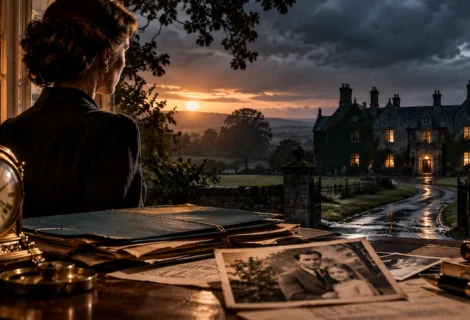
The Last Confession of Annabel Hargreaves

The Last Confession of Annabel Hargreaves

At eighty-four, Annabel Hargreaves has impeccable manners, a formidable reputation and a past nobody has ever questioned. Then, one rainy Tuesday morning, she walks into a police station and confesses to three murders.
A Lady With an Appointment
Annabel Hargreaves arrived at Cheltenham Police Station at precisely nine seventeen on a wet Tuesday morning, carrying a crocodile-pattern handbag, a neatly folded umbrella and a paper bag containing two almond croissants.
She was eighty-four, dressed in a beautifully tailored navy coat, and had the upright posture of a woman who had spent most of her adult life expecting people to listen when she spoke. Her silver hair was immaculate, her lipstick discreetly expensive, and her expression suggested that the world had been disappointing her for some time.
The young constable behind the reception desk looked up from his computer.
“Can I help you, madam?”
“I should certainly hope so. Otherwise, this is a rather expensive building in which to keep a kettle.”
He smiled uncertainly. “Are you here to report something?”
“Yes. Three murders.”
The smile disappeared.
“Were you a witness?”
“Not exactly.”
“Would you like to take a seat while I get somebody?”
“Thank you, but I’ve been sitting down for most of the morning. At my age, one has to make the most of one’s knees while they’re still prepared to cooperate.”
He reached for a form and asked for her name.
“Annabel Hargreaves. Former Detective Chief Superintendent. Retired in 2001. You may find my photograph upstairs, although I sincerely hope somebody has taken it down.”
Recognition flickered across his face. He had heard the name during training, usually attached to stories about difficult investigations and senior officers who had underestimated her at their peril.
“And these murders, Miss Hargreaves? What exactly are you reporting?”
Annabel placed her handbag on the counter and regarded him with something approaching sympathy.
“My dear boy, I’m trying to tell you that I committed them.”
For a moment, the only sound came from a coffee machine hissing somewhere behind reception.
Annabel glanced at the clock.
“Now, if somebody could arrange a proper interview before ten, I’d be grateful. I have a hair appointment at half past eleven, and my hairdresser becomes quite unreasonable if I cancel without notice.”
A Reputation Built on Certainty
Detective Inspector Nathan Cole had been halfway through a bacon sandwich when the duty sergeant telephoned. At forty-one, he had sixteen years of police service behind him, a failed marriage and the unfortunate habit of eating lunch whenever the opportunity presented itself, regardless of the time.
He assumed the elderly woman downstairs was confused until the sergeant mentioned her name.
Annabel Hargreaves was something of a legend in Gloucestershire policing. She had joined the force in the early 1960s, when women were routinely assigned duties considered suitable for their supposedly delicate constitutions, and had risen through the ranks with a determination that made her both admired and feared. She’d received a Queen’s Police Medal, led several major investigations and once reduced a visiting Home Office official to tears during a disagreement about staffing.
Nathan had heard that last story from three different people. All three had enjoyed telling it.
When he entered the interview room, Annabel was examining a paper cup of tea with obvious disappointment.
“Detective Inspector Cole,” he introduced himself.
“I know. You have your father’s eyes, although fortunately not his handwriting.”
Nathan stopped beside the chair. His father, Peter Cole, had been a police surgeon for decades and had died eight years earlier.
“You knew my father?”
“Very well. A competent man with a dreadful sense of direction. He once drove to the wrong mortuary and spent twenty minutes arguing with a caretaker.”
Despite himself, Nathan smiled.
He explained the seriousness of her statement and the need for a formal interview.
“Inspector, I’m eighty-four, not an idiot. I know perfectly well what happens when somebody confesses to murder. I spent forty years listening to people do it, although most of them were considerably less punctual.”
Annabel requested a solicitor. While arrangements were made, Nathan asked whether she needed medical assistance or wanted anybody contacted.
“No, thank you. My neighbour is feeding the cat, and I’ve left instructions concerning the begonias.”
“You have a cat?”
“Certainly not. I dislike cats. But Mrs Wilkins has one, and she seems incapable of remembering to feed it when she’s away.”
Nathan was still considering that answer when Annabel added, “And Inspector, do something about your cuff. You’ve got brown sauce on it.”
He looked down.
There was indeed a small stain.
For the first time that morning, Nathan began to appreciate why generations of police officers had found Annabel Hargreaves so difficult.
Annabel was arrested on suspicion of murder shortly afterwards. Her hair appointment was cancelled, and her solicitor, Harriet Lowe, arrived to find her client complaining that the custody-suite tea was even worse than the offering downstairs.
The First Dead Man
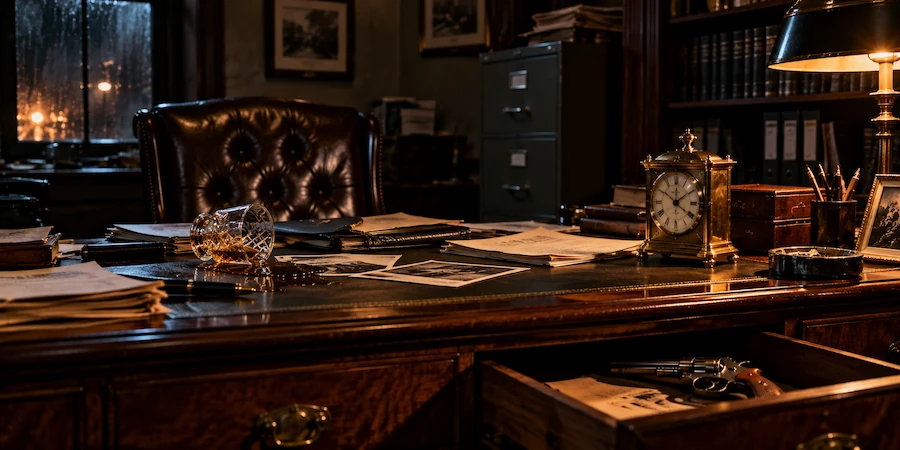
With Harriet present and the interview formally recorded, Annabel began with Graham Pritchard, a wealthy haulage businessman found shot in his Cheltenham office in October 1984.
Nathan knew the case. Pritchard’s business partner, Leonard Marsh, had been convicted following a dispute over missing company funds. Marsh had protested his innocence until his death in prison twelve years later.
Annabel had led the original investigation.
“I shot Graham Pritchard,” she said. “And I allowed Leonard Marsh to be convicted for it.”
She described the office, the position of the desk and the revolver Pritchard kept in its bottom drawer. Her recollection was detailed enough to be convincing, although Nathan knew better than to treat detail as proof.
Pritchard, she explained, had been involved in exploiting vulnerable young women and girls at a country property outside Cheltenham. He kept photographs and financial records, partly to protect himself from the influential men who visited.
One of the girls was seventeen-year-old Susan Bell.
Susan had already given Annabel a handwritten statement describing what happened at Pritchard’s country property. A police search was being prepared, but before it could take place, Susan disappeared. Two days later, officers were due to search the house.
“I went to Graham’s office because I believed somebody had warned him,” Annabel said. “He knew things that should never have left the investigation team.”
“What happened?”
“He laughed. Told me a frightened girl wasn’t worth destroying the careers of important men.”
For the first time, Annabel’s composure weakened.
“He reached for his revolver. We struggled, I took it from him, and I shot him.”
She admitted altering evidence and directing suspicion towards Leonard Marsh, who had previously threatened Pritchard.
“I told myself Leonard was a criminal anyway. He’d stolen from the business, and I persuaded myself his conviction was an unfortunate necessity.”
“Necessary for whom?” Nathan asked.
“For me. Although I didn’t have the honesty to admit that then.”
The answer troubled him more than an elaborate excuse would have done.
Annabel also confessed to killing Frederick Vale, a solicitor, in 1991, and Malcolm Renshaw, a former Assistant Chief Constable, in 1998. Both had been connected to the Pritchard investigation.
Vale had died at home, his death attributed to complications of an existing heart condition. Annabel claimed she’d poisoned him after discovering that he was destroying records connected to Pritchard’s country property.
She described how she’d obtained the poison and the violent symptoms that followed. More significantly, she told Nathan about a small bottle she’d hidden behind the lining of a jewellery box, together with the original label from the dispensing chemist.
“I kept it because I was frightened somebody might find the purchase recorded elsewhere,” she admitted. “Which, looking back, was an exceptionally stupid reason to preserve evidence of murder.”
Nathan recorded the account carefully. The bottle might corroborate her possession of poison, but establishing what had killed Vale after thirty-five years would require independent evidence.
Renshaw had been found drowned near his lakeside cottage. Annabel admitted striking him during an argument, then pushing him into the water while he was still alive.
“Why?”
“He wanted to reopen the Pritchard case. He knew Leonard Marsh was innocent.”
“And you killed him to stop him?”
Annabel lowered her eyes.
“Yes.”
Nathan watched her for several seconds. She’d confessed to three deaths with remarkably little prompting, but whenever he asked about Susan Bell, her answers became more guarded.
It was as though she wanted him to understand the murders without understanding the girl who connected them.
The Woman Who Asked Better Questions
Detective Sergeant Priya Shah joined the investigation that afternoon. She was thirty-four, methodical and possessed the useful ability to remain unimpressed by people who expected their reputations to enter a room before them.
After reviewing Annabel’s interview, she leaned back in her chair.
“She’s very good.”
“At confessing?”
“At controlling you. She tells you something shocking, lets you recover, then gives you another detail before you’ve properly examined the first.”
Nathan couldn’t disagree.
Priya had noticed something else. Annabel had supplied dates, locations and incriminating details about all three men, yet she’d said almost nothing about the last occasion on which Susan Bell had been seen alive.
“That’s the part she keeps moving away from,” Priya observed. “Every time you ask about Susan, she takes you back to Pritchard.”
The detectives began reviewing the surviving case material, but Priya insisted they work from the original records rather than Annabel’s account. Forty-two years was a long time for evidence to disappear, memories to change and mistakes to become accepted facts.
Among the photographs of Pritchard’s office was a brass clock beside a filing cabinet. Annabel had mentioned the clock during her interview, claiming it hadn’t been there when she first entered the office on the night of Pritchard’s death. Priya could find no record of its recovery.
In another photograph, taken from a slightly different angle, the clock was absent altogether.
She compared the negative numbers. The photographs belonged to separate sequences.
“Somebody changed the room after the first photographs were taken,” she said.
Nathan leaned over her shoulder.
“Or the clock was removed.”
“Possibly. But why mention it after forty-two years?”
She requested the original scene log and asked for the photographer to be traced.
There was something deliberate about Annabel’s recollection. Priya wasn’t yet certain whether the clock was a clue or an invitation.

The Girl Who Disappeared
Susan Bell’s remains had been discovered in woodland in February 1985, four months after she disappeared.
She’d been seventeen, worked part-time in a café and lived with her widowed mother near Gloucester. Her school photographs showed a dark-haired girl with a broad smile and a crooked front tooth.
Nathan found himself returning to that photograph.
For forty-two years, Susan had been reduced to a name in police records, an unresolved murder and a collection of statements from people who’d known her.
Her surviving relatives described a girl who loved horses, saved for driving lessons and wanted to become a veterinary nurse. She’d been offered occasional catering work through her uncle, David Fenwick, a bookkeeper with connections to Graham Pritchard.
Fenwick was still alive.
At sixty-nine, he lived comfortably outside Stroud, having retired from accountancy several years earlier.
Nathan and Priya visited him without warning.
Fenwick was a neat, nervous man whose sitting room contained expensive furniture and very little evidence of anybody actually living there.
“I introduced Susan to somebody who needed help with catering,” he told them. “I didn’t know what went on at that house.”
“Did Susan ever ask you to stop taking her there?” Priya asked.
Fenwick hesitated.
“She was a teenager. Teenagers change their minds about everything.”
Priya noticed that he spoke of Susan with the irritation of somebody recalling an inconvenience rather than the affection of a grieving uncle.
As they left, Fenwick asked whether Annabel Hargreaves had mentioned him.
Nathan hadn’t told him Annabel was involved in their enquiry.
On the drive back, Priya stared through the rain-streaked windscreen.
“He’s frightened of her.”
“Or of what she knows.”
“Possibly both.”
A Missing Policeman
Andrew Kellett had been a junior detective on the Pritchard investigation. His name appeared repeatedly in connection with witnesses whose statements had changed.
Nathan telephoned him on Thursday afternoon.
Kellett sounded irritated when Annabel’s name was mentioned.
“What’s she done now?”
“I’d prefer to discuss that in person.”
“I’m going away.”
“When?”
“Tomorrow.”
“Where?”
“That’s private.”
Nathan asked him to remain available and arranged for local officers to visit.
By the time they arrived that evening, Kellett’s front door was unlocked, his car was still in the drive and a half-finished cup of coffee stood on the kitchen table. A chair had been overturned in the study, and blood marked the edge of a wooden desk.
Kellett was missing.
Nathan returned to Annabel, who was being held in custody while enquiries continued.
“When did you last speak to Andrew Kellett?”
“Monday morning.”
“What did he want?”
“Money.”
“For what?”
“Silence.”
Annabel explained that Kellett had discovered her involvement in Pritchard’s death and blackmailed her for years.
“Did he threaten to expose you recently?”
“Yes.”
“Did you threaten him?”
“I told him I was tired of being frightened.”
Nathan leaned forward.
“And what did he say?”
“He laughed.”
It was the same word she’d used when describing Graham Pritchard’s final moments.
This time, however, she didn’t sound angry.
She sounded afraid.
The Body in the Quarry
Kellett’s body was discovered on Saturday in a disused quarry lake. He’d suffered a severe head injury before entering the water, and the initial findings were consistent with an assault on Thursday evening.
Annabel had been in police custody throughout that period. She couldn’t have killed him herself, but Nathan was increasingly convinced she’d known he was in danger.
The investigation into Kellett’s finances revealed regular payments from a small consultancy company linked to David Fenwick. The amounts had increased sharply during the previous year.
Priya examined the payment dates alongside the surviving Pritchard files and noticed that several transfers coincided with occasions when Fenwick had been approached about Susan’s disappearance.
“Kellett was charging him to keep quiet,” she said.
“About Susan?”
“That’s what we need to establish.”
Rather than rely on Kellett’s incomplete records, Priya traced the consultancy company’s banking history and identified a solicitor who’d handled its closure. The solicitor confirmed that Kellett had demanded a substantial final payment shortly before Annabel’s confession.
There was now a plausible motive for Fenwick to confront Kellett, although not enough evidence to prove he’d killed him.
The breakthrough came when Priya returned to the altered witness index.
One missing statement had been referenced in a surviving letter from Susan’s mother. It was described as a handwritten account Susan had given Annabel two days before she disappeared.
Yet the statement itself had never appeared in the prosecution papers or the later review of Susan’s case.
Priya looked at Nathan.
“Annabel didn’t simply lose this. She took it out.”
The Blue Folder
Nathan hadn’t opened his father’s old notebooks since the funeral.
They occupied two cardboard boxes in the spare bedroom, beneath a folded winter duvet and a photograph of Peter Cole standing beside his first police car. Nathan had meant to sort through them for years, but there had always been something more urgent to do, or something less painful.
That evening, he carried the boxes downstairs and spread their contents across the dining table.
Peter’s handwriting was as dreadful as Annabel had promised. Nathan recognised the cramped letters immediately, along with his father’s habit of underlining words twice when he was annoyed.
For nearly an hour, he found nothing unusual: dates, examinations, observations and occasional complaints about senior officers who expected medical conclusions to accommodate their preferred theories.
Then he reached November 1984.
Pritchard. Original time of death inconsistent with later report. A.H. aware. Kellett present before scene secured.
Nathan read the entry again.
His father had signed the report used at Leonard Marsh’s trial. Nathan remembered seeing a copy in the archived case papers, its conclusions presented as unremarkable medical fact.
On the next page was a reference to Susan Bell.
Evidence of prolonged captivity. Findings disputed. Do not trust Kellett.
Beneath it, Peter had written:
Blue folder. Annabel knows.
Nathan remained at the table long after he’d finished reading. He remembered his father lecturing him about the importance of accurate notes, about never allowing an investigating officer to influence a medical opinion, and about how a small dishonesty could ruin an otherwise sound case.
He could almost hear the familiar voice.
The truth doesn’t become less important because it’s inconvenient, Nathan.
It was difficult to reconcile that man with the one who had apparently helped conceal a murder.
When Priya arrived the following morning, she found Nathan sitting in his office with the notebooks open.
He showed her the entries without explaining how he’d felt when he discovered them.
She read them carefully, then closed the book.
“We need somebody independent to examine these,” she said.
Nathan nodded.
“And you shouldn’t be making decisions about evidence involving your father.”
“I know.”
It hurt to hear her say it, but she was right. Nathan disclosed the connection and stepped back from decisions concerning Peter’s conduct, while Priya continued the enquiries with independent oversight.
The subsequent search of Annabel’s home was conducted under warrant.
Her study overlooked a narrow garden where the roses had been cut back for winter. Books lined two walls, and framed photographs recorded a career of commendations, retirement dinners and handshakes with people who’d once held considerable power.
Priya noticed that the shelves were immaculate except for one section beside the fireplace. A narrow strip of dust had been disturbed, and the wooden backing didn’t sit quite flush with the wall.
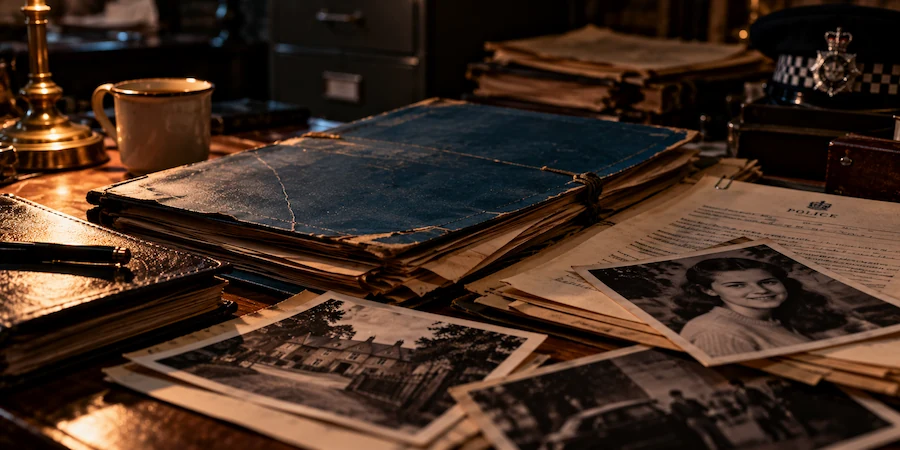
Behind it was a blue folder.
Inside were original notes, correspondence and Annabel’s signed account of the Pritchard shooting, written in December 1984. Peter Cole had arrived after she telephoned him in panic and had subsequently helped conceal the true timing of Pritchard’s death.
There was also a letter from Peter, dated 2004.
I have spent twenty years telling myself that I helped you protect Susan’s case. The truth is that I helped you protect yourself.
Priya read the letter twice.
She knew Nathan would have to see it eventually, and that no amount of careful wording would make the discovery easier.
For the moment, she placed it in an evidence sleeve and continued the search.
The forensic team recovered the jewellery box Annabel had described during her confession. Behind its lining was a small glass bottle with a damaged label, along with an old chemist’s receipt bearing her name.
The laboratory identified traces of a poisonous substance in the bottle. It was evidence that Annabel had possessed the material, but it could not, by itself, establish what had caused Frederick Vale’s death.
Priya asked the reviewing pathologist to examine Vale’s surviving hospital and post-mortem records. She also requested a search for any retained specimens, although the pathologist warned that material from 1991 might no longer exist.
A week later, the records department located a sealed specimen retained after an unexplained laboratory finding shortly before Vale’s death. It had remained in specialist storage because the result had never been reconciled with the original conclusion.
Independent testing confirmed the presence of the same poisonous substance. The pathologist’s subsequent report concluded that poisoning had materially contributed to Vale’s fatal deterioration.
Priya read the report carefully before placing it beside Annabel’s confession.
At last, the second murder rested on more than Annabel’s word.
The Mistake That Changed Everything
The blue folder contained Susan Bell’s missing statement.
Susan described being taken to Pritchard’s country property by her uncle, David Fenwick. She named several men and explained that Kellett had warned her not to speak to the police.
Her final paragraph was particularly troubling.
I’m frightened of Uncle David. He’s the one who decides when I can leave.
Priya confronted Annabel with the statement during a further recorded interview, with Harriet present.
“You had this in 1984.”
“Yes.”
“You knew Fenwick was involved.”
“I knew he was taking Susan to the house. I didn’t know he’d killed her.”
“Then why hide her statement?”
“Because Kellett knew about Graham’s murder. He threatened to expose me if I pursued Fenwick.”
Priya stared at her.
“So you let Fenwick go free.”
“Yes.”
“And instead you killed Frederick Vale and Malcolm Renshaw.”
Annabel looked down.
“Frederick was helping destroy the financial records. I believed he knew where Susan had been held. I went to his house intending to frighten him into talking. When he refused, I put poison in his drink.”
“Did you know it would kill him?”
“I knew it could. He became violently ill while I was there. I left without calling for help.”
“And Malcolm?” Priya asked.
“Malcolm discovered Kellett’s blackmail. He wanted me to confess and reopen Susan’s case properly.”
“He was trying to help?”
“He was trying to do what I should have done years earlier.”
“And you killed him because he threatened your career.”
Annabel’s eyes filled with tears.
“I killed him because I was afraid of losing everything.”
Priya sat back.
For years, Annabel had been praised as a woman who never allowed personal feelings to interfere with her investigations.
Now Priya understood how thoroughly she’d deceived herself.
She hadn’t killed three men in the pursuit of justice. She’d shot one in anger, poisoned another because she believed he was withholding information and drowned a third because he threatened to expose her.
Then she’d spent decades convincing herself that her victims had deserved their fate.
The Woman Who Wouldn’t Forgive Her
Rebecca Marsh had spent most of her adult life trying to clear her father’s name.
At fifty-one, she’d become accustomed to explaining the same facts to different people, watching their expressions settle into polite sympathy before they told her there was nothing more to be done.
Her dining table was covered with folders when Priya and Nathan visited. Newspaper cuttings, correspondence and copies of old court documents were arranged in neat piles, each labelled with a year.
“My husband says I should have charged admission,” Rebecca remarked as she cleared two chairs. “I’ve practically opened a museum.”
She smiled briefly, but the humour didn’t reach her eyes.
Six weeks before Annabel’s confession, Rebecca had visited her at home.
“I’d written to her before. Several times. She never answered. So I went there myself.”
Annabel had invited her inside, offered tea and listened while Rebecca explained the inconsistencies she’d found in the case against Leonard.
“She was perfectly pleasant,” Rebecca said. “That’s what made it worse. She sat there in that beautiful room, with all her photographs and awards, while I told her what prison had done to Dad.”
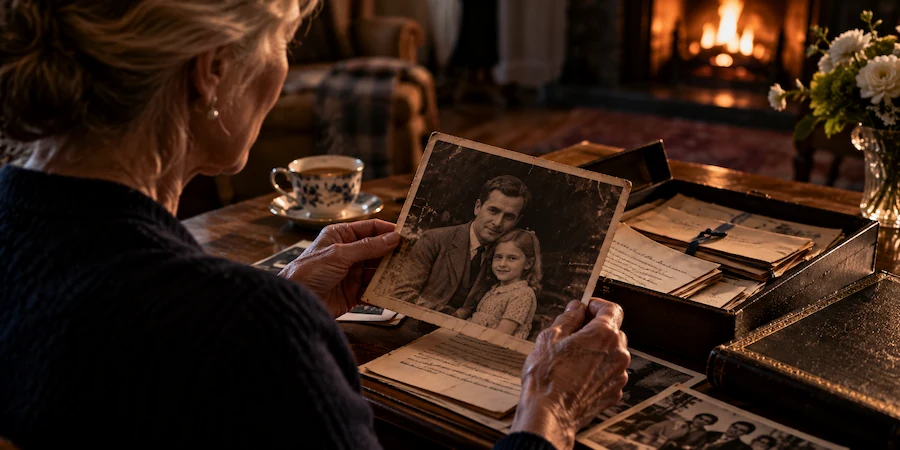
Rebecca reached for a photograph showing a smiling man holding a little girl on a beach.
“I showed her this. He’d taken me to Weston-super-Mare. I remember the wind was so strong my ice cream blew off the cone, and he bought me another even though he couldn’t really afford it.”
She ran her thumb along the edge of the photograph.
“Annabel looked at him for a long time. Then she told me the evidence had been clear.”
“What did you say?” Priya asked.
“I told her I didn’t believe her.”
A fortnight later, Annabel had appeared unexpectedly at Rebecca’s door.
“She looked different. Tired. She said she’d made a terrible mistake and intended to put it right.”
“Did she explain?”
“No. I asked her whether she’d known Dad was innocent. She wouldn’t answer.”
Rebecca looked up.
“I told her to leave. I thought she wanted me to forgive her before she’d even admitted what she’d done.”
Nathan studied the photograph.
“My father helped with the original investigation,” he said quietly. “I’m sorry.”
Rebecca considered him for a moment.
“Then you’ll understand why apologies aren’t enough.”
He nodded.
Rebecca put the photograph back on the table.
“I want his name cleared. And I want the truth somewhere nobody can put it in a drawer and forget about it again.”
Priya glanced at the folders spread across the dining table. Most contained newspaper cuttings, correspondence and copies of court documents, but one was considerably thinner than the others.
“What’s in that one?”
Rebecca followed her gaze.
“Things I haven’t been able to explain.”
She opened it and took out a photocopy of an old letter. It was dated December 1984, two months after Graham Pritchard’s murder, and addressed to Leonard Marsh’s solicitor.
“It was found among Dad’s old case papers. His solicitor thought it was nonsense. I didn’t.”
The letter contained only three sentences.
The evidence against Mr Marsh is not what it appears. Ask who entered Pritchard’s office after the first photographs were taken. Ask why the clock was never recorded.
There was no signature.
Nathan read it twice.
“Where did it come from?”
“I don’t know who wrote it,” Rebecca said. “It was in the solicitor’s file when his daughter passed the papers to me.”
“Did you show this to Annabel?”
Rebecca hesitated.
“Yes.”
“When?”
“Six weeks ago. When I went to her house.”
“And what did she say?”
“She went very quiet. Then she asked whether I had the original.”
“Did you?”
“I told her I had a copy.”
Priya watched her.
“Did she ask whether you had anything else?”
“Yes.”
“What did you say?”
“That I wasn’t prepared to discuss it.”
For a moment, nobody spoke.
“Two weeks later,” Rebecca continued, “she came to my house. She said she’d made a terrible mistake and intended to put it right.”
“Did she ask about the letter again?” Priya asked.
“Yes. Before she left.”
“And what did you tell her?”
“That she’d have to decide whether she wanted the truth to come out while she was still alive.”
Nathan looked at the photograph of Leonard Marsh.
Rebecca’s voice was steady when she spoke again.
“I don’t want Annabel remembered as some extraordinary old woman who finally found her conscience. She had forty-two years to find it. My father died waiting.”
Nathan promised that the evidence would be pursued.
Rebecca didn’t thank him.
After so many years, she had learned to wait for results.
A Reputation in Ruins
David Fenwick was arrested after investigators established his financial connection to Kellett and recovered evidence placing him at Kellett’s home on the evening he disappeared.
He denied killing Susan, insisting he’d only arranged transport and payments.
The enquiry into her death continued, supported by the recovered statement, old witness accounts and evidence of Fenwick’s role at the country property.
Investigators also examined the circumstances of Kellett’s death separately. Fenwick eventually admitted confronting him over the blackmail and striking him during a fight, although he disputed intending to kill him.
Nathan was relieved that the evidence had finally begun to speak more clearly than the people involved.
Annabel, meanwhile, had become national news.
Former colleagues described her as brilliant, intimidating and fiercely principled. Others remembered a woman who’d been ruthless with suspects and intolerant of mistakes.
Annabel found the attention tiresome.
“It’s extraordinary,” she told Harriet Lowe. “One can spend forty years being called formidable, and the moment one admits to murder, everybody becomes terribly surprised.”
But her humour deserted her when Rebecca Marsh attended a court hearing.
Rebecca sat in the public gallery holding her father’s photograph.
She didn’t shout or cry. She simply looked at Annabel, who found herself unable to meet her eyes.
Later, Annabel asked Harriet to arrange for Rebecca to receive the Christmas letters Leonard had sent from prison.
There were twelve.
Annabel had kept every one.
She included a note.
Your father told the truth. I knew it, and I allowed him to suffer. There is no explanation that makes that forgivable. I am sorry.
Rebecca didn’t reply.
Annabel hadn’t expected her to.
The Clock That Wasn’t There
The breakthrough came from an unlikely source: a retired police photographer named Martin Ellery, who had spent the intervening decades photographing weddings and complaining that digital cameras had ruined the profession.
He remembered Pritchard’s office.
“Awful place,” he told Priya. “Smelled of cigars and expensive aftershave. Somebody had knocked over a glass of whisky, and the carpet was still damp.”
Priya showed him the photograph of the brass clock.
“Do you remember this?”
Ellery frowned.
“That wasn’t there when I arrived.”
Priya felt the familiar tightening of attention that came when a small detail suddenly mattered.
“Are you certain?”
“Quite. I took the first photographs before anybody moved anything. That one was taken later, after I’d been asked to photograph the room again.”
“Who asked?”
“Annabel Hargreaves.”
Priya examined the surviving negatives. Ellery was right. The first sequence showed an empty space beside the filing cabinet. The clock appeared only in the later photographs.
She also found a handwritten note in the scene log recording that Annabel had returned to the office with Andrew Kellett after the initial examination.
The clock hadn’t been overlooked during the search.
It had been introduced afterwards.
Priya traced the manufacturer through an old trade catalogue. The model was a presentation clock, commonly engraved with the recipient’s name.
Then she found an entry in Pritchard’s business records.
Presentation clock — D. Fenwick — October 1984.
It had been purchased three days before Pritchard died.
The business records also included a delivery note. The clock had been sent to Fenwick at Pritchard’s offices, where he worked.
Priya compared the delivery date with the scene log. Annabel had returned to the building after the initial photographs, accompanied by Kellett. Both had access to the offices where the clock had been delivered.
That explained how it could have been moved, but not why Annabel had wanted it there.
Priya arranged another interview with Annabel.
“Why did you put the clock in Graham Pritchard’s office?” she asked.
Annabel’s expression remained composed, but she didn’t answer immediately.
“I thought it might help identify who’d been there.”
“You knew it was connected to Fenwick.”
“Yes.”
“You were trying to implicate him in Pritchard’s murder.”
“I was trying to make somebody investigate him.”
“By planting evidence.”
Annabel looked down.
“Yes.”
“Why wasn’t it entered into the property register?”
“I told Kellett it was an office ornament that had been moved during the search. He accepted my explanation.”
“Or he already knew what you’d done.”
Annabel didn’t answer.
Priya studied her.
“You didn’t simply frame Leonard Marsh because he was convenient. You also tried to direct suspicion towards Fenwick, but when that failed, you allowed Leonard to take the blame.”
Annabel’s eyes filled with tears.
“I thought if Fenwick became frightened enough, he’d tell me what had happened to Susan.”
“And when he didn’t?”
“I kept waiting.”
Priya closed the file.
For forty-two years, Annabel Hargreaves had told herself she’d been trying to find Susan’s killer.
The truth was uglier.
She’d repeatedly manipulated evidence to make other people act, rather than face the consequences of what she’d done herself.
“There’s something else,” Priya said. “An anonymous letter was found in Leonard Marsh’s solicitor’s papers. It mentions the clock and the second set of photographs.”
Annabel’s expression changed.
Only slightly, but Priya noticed.
“Who wrote it?” Annabel asked.
“We don’t know.”
“Then perhaps you should find out.”
“Was it you?”
“No.”
“Andrew Kellett?”
Annabel looked towards the window.
“I couldn’t possibly say.”
Priya waited, but Annabel offered nothing further.
For the first time since the interviews began, the elderly detective seemed less interested in controlling the conversation than in ending it.
The Last Interview
Three weeks after Annabel’s arrest, Nathan visited her in custody.
She was sitting beside a window, wearing a pale blue cardigan and reading a gardening magazine.
“Inspector Cole. How lovely. Have they finally repaired the coffee machine?”
“Not yet.”
“Civilisation continues its decline.”
He sat opposite her.
“Fenwick has admitted his involvement in Kellett’s death.”
“I heard.”
“The investigation into Susan’s murder is continuing.”
“Good.”
Nathan studied her.
“You could have given us the blue folder years ago. You could have cleared Leonard Marsh and exposed Fenwick and Kellett.”
“Yes.”
“But you didn’t.”
“No.”
“Why confess now?”
Annabel closed her magazine.
“Because Rebecca Marsh came to see me.”
Nathan frowned.
“You told us you’d visited her.”
“She came to my house first. She showed me a photograph of Leonard holding her on a beach. I remembered him in the interview room, frightened and insisting he hadn’t killed Graham.”
Her voice faltered.
“I remembered thinking that if I could make him confess, everything would be easier.”
Nathan said nothing.
“And I realised I’d spent forty-two years doing exactly what I despised in other people. Protecting myself.”
“Then why involve Fenwick and Kellett?”
“Because I wanted Susan’s killer exposed as well.”
“You could have come to us.”
“I didn’t trust the police.”
Nathan raised an eyebrow.
Annabel gave a sad smile.
“I appreciate the irony.”
He stood.
“There’s one thing I still don’t understand. Why ask for me?”
“Because your father knew the truth. And I thought his son deserved to hear it from me.”
“You could have written.”
“I could.”
“So why didn’t you?”
“Because I wanted you to look me in the eye when I told you what we’d done.”
Nathan reached the door.
“Inspector?”
He turned.
“Your father wasn’t a monster. He was a man who made a terrible decision and then lacked the courage to correct it. Please don’t spend the rest of your life pretending those are the same thing.”
Nathan looked at her.
“And what are you?”
Annabel considered the question.
“A woman who made several terrible decisions,” she said. “And was rather too good at explaining them to herself.”
The Last Confession
By the following spring, the investigation had reached a conclusion Annabel Hargreaves could no longer influence.
She pleaded guilty to the murders of Graham Pritchard and Malcolm Renshaw. In Frederick Vale’s case, the recovered specimen and independent medical findings supported the prosecution’s conclusion that poisoning had caused his death. Annabel also pleaded guilty to his murder.
She admitted offences relating to the falsification and suppression of evidence in Leonard Marsh’s case.
The judge imposed a life sentence for each murder, to run concurrently, with a substantial minimum term. At eighty-four, Annabel understood what that meant.
Leonard Marsh’s conviction had been quashed by the Court of Appeal following the disclosure of the new evidence. His daughter Rebecca was present when the decision was announced, holding the photograph of her father on the beach.
She didn’t smile.
Later, she told a reporter that she’d spent forty-two years wanting to hear the words wrongly convicted, and had discovered they were both everything she’d hoped for and nowhere near enough.
Susan Bell’s murder investigation continued separately. David Fenwick faced charges connected to her death and the killing of Andrew Kellett.
When Annabel was invited to speak before sentence, she rose slowly.
“I spent most of my career telling people that the law applied to everyone,” she said. “I was very good at saying it.”
A faint rustle moved through the courtroom.
“I also spent a considerable portion of that career believing my judgement was superior to the law. That is a dangerous quality in a police officer. It is even more dangerous in one who is usually right.”
She glanced towards Rebecca Marsh.
“I was not always right.”
Her voice softened.
“I cannot return the years I stole from Leonard Marsh. I cannot bring back the men I killed. And I cannot pretend that the suffering of Susan Bell gave me permission to decide who deserved to live.”
For the first time, she struggled to continue.
“I used to believe that a confession was something a detective obtained from somebody else. I have discovered that making one is considerably harder.”
She sat down.
There were no jokes after that.
Some things, Annabel had finally learned, did not need improving with a clever remark.
Several weeks after Annabel’s sentencing, Nathan received a letter.
The envelope was cream, the handwriting elegant.
Inside was a single sheet of paper.
Dear Inspector Cole,
I imagine you’ve had enough of me to last several lifetimes, but I wanted to thank you.
You did something I failed to do when I was young and certain of my own brilliance. You followed the evidence even when it led somewhere painful.
Your father would have been proud of you. I hope, in time, you can be proud of him for the good he did without excusing the harm he caused.
As for me, I am adjusting to my circumstances. The food is dreadful, the gardening facilities are an insult to horticulture, and somebody has attempted to organise a committee without establishing who is in charge.
I have volunteered to help.
They appear nervous.
Yours sincerely,
Annabel Hargreaves
Nathan smiled despite himself.
Then he noticed the postscript.
P.S. I understand Detective Sergeant Shah finally solved the mystery of the brass clock. Please congratulate her. It took rather longer than I’d anticipated, but then I suppose one shouldn’t expect everybody to think as quickly as I do.
He read the line again.
Annabel had known Priya would investigate the clock. She’d mentioned it during her confession, almost inviting them to examine the old photographs.
He telephoned Priya.
“Do you remember the anonymous letter Rebecca Marsh showed us?”
“Of course.”
“Annabel denied writing it.”
“Yes.”
“Did we ever establish who did?”
“Not conclusively. Why?”
“Because Annabel’s just written to me about the clock. She sounds rather pleased with herself.”
Priya was quiet for a moment.
“I think we should speak to Rebecca again.”
Rebecca Marsh opened her front door wearing gardening gloves.
“Oh,” she said, seeing Nathan and Priya. “I thought you were the man about the fence.”
“Sorry to disappoint you,” Nathan said.
“Don’t be. He’s disappointed me three times already.”
She invited them into the kitchen, where a kettle was boiling and a half-finished crossword lay beside a plate of biscuits.
Priya explained that they were reviewing the anonymous letter.
Rebecca listened without interruption.
“Have you found out who wrote it?” she asked.
“Not yet,” Priya said. “But we wondered whether you might know more about its history.”
Rebecca took off her gloves.
“The copy was in Dad’s solicitor’s papers. That’s where I found it.”
“And the original?” Nathan asked.
Rebecca looked at him.
“What about it?”
“You told us you had a copy.”
“I did.”
“Do you still?”
“Of course.”
“May we see it again?”
Rebecca fetched the folder from the dining room. Inside was the same photocopy, its corners softened by years of handling.
Priya examined it.
Then she noticed something she hadn’t seen during their first visit.
The letter had been copied onto a sheet bearing the faint outline of a solicitor’s filing stamp. Along the bottom was a handwritten reference number.
“Was this copied from your father’s solicitor’s archive?” she asked.
“Yes.”
“Who made the copy?”
“The solicitor’s daughter. She gave me the papers last year.”
“Did she give you anything else?”
Rebecca’s expression changed.
It was brief, but unmistakable.
“Yes.”
“What?”
Rebecca sat down.
For a long moment, she stared at the photograph of her father on the mantelpiece.
Then she rose and crossed to a cupboard beside the kitchen door. From the top shelf, she took a small metal document box.
Inside were two envelopes, both yellowed with age.
She placed them on the table.
“The first is the original anonymous letter,” she said. “The second was sealed when it came to me.”
Priya examined the envelopes.
The original warning bore the solicitor’s filing stamp. The second envelope had been addressed to the same solicitor, but the address was crossed out. Across the front, in a different hand, somebody had written:
Not sent. Keep with Marsh papers.
“Where did this come from?” Priya asked.
“The solicitor’s daughter found it among her father’s private files. She didn’t know why he’d kept it.”
Priya opened the second envelope carefully.
Inside was a carbon copy of a statement.
Nathan recognised the name at the bottom immediately.
Peter Cole.
His father’s signature.
The statement was dated November 1984, and it described the alteration of Pritchard’s time-of-death evidence. Peter had written that Annabel Hargreaves instructed him to amend his findings after admitting she’d shot Pritchard.
It also named Andrew Kellett as a witness to their discussion.
Nathan stared at the page.
“Why wasn’t this given to the police?”
Rebecca looked at him.
“Because your father never sent it.”
Priya studied the envelope again.
“How do you know?”
“There’s a note attached. Written by the solicitor.”
Priya unfolded a small sheet tucked behind the statement.
It recorded a meeting with Peter Cole in December 1984. Peter had brought the statement to Leonard Marsh’s solicitor but had refused to let him use it unless Annabel’s involvement could be concealed.
The solicitor had warned him that such a condition was impossible.
Peter had taken the original statement away.
The carbon copy remained in the solicitor’s file.
Nathan read the note twice.
His father had come close to telling the truth.
Then he’d walked away.
“Who wrote the anonymous letter?” Priya asked.
Rebecca looked at her.
“My father.”
Nathan frowned.
“Leonard Marsh?”
“Yes.”
“But he was in custody.”
“He wrote it after your father visited him on remand.”
Nathan looked down at the statement again.
“Peter went to see Leonard?”
Rebecca nodded.
“He told Dad the evidence had been changed. He wouldn’t admit exactly what he’d done, but he said the timing was wrong and that somebody had interfered with the scene.”
“Why would he tell Leonard that?”
“Perhaps he wanted to confess without actually having to confess.”
Priya considered the documents.
“Leonard wrote the warning and sent it to his solicitor?”
“Yes. Dad thought that if his solicitor started asking questions about the clock and the photographs, somebody would finally investigate what had happened.”
Nathan stared at his father’s signature.
Peter had known Leonard Marsh was innocent.
He’d told him enough to give him hope, then refused to stand behind the truth.
Rebecca watched Nathan read.
“I’m sorry,” she said.
He shook his head.
“Don’t apologise for what he wrote.”
Priya turned to Rebecca.
“And you showed Annabel the photocopy six weeks before she confessed.”
“Yes.”
“But not this statement.”
“No.”
“Why?”
Rebecca folded her hands.
“Because I wanted to see whether she’d tell the truth without knowing exactly what I had.”
Nathan looked at her.
“What happened when you visited Annabel?”
Rebecca took a breath.
“I showed her the photograph of Dad. I told her I’d spent forty-two years trying to prove he was innocent. Then I showed her the anonymous letter.”
“And?”
“She asked whether I had the original. I told her I had something more important.”
“Did you tell her about Peter’s statement?”
“No. I told her that if she didn’t put things right, I’d take what I had to the police.”
Priya glanced at Nathan.
“And two weeks later, Annabel came to your house.”
Rebecca nodded.
“She wanted to know whether I’d told anybody else. I said I hadn’t.”
“Why not?”
“Because I wanted her to make the choice herself. I wanted her to have to walk into a police station and say the words.”
Nathan sat back.
For months, he’d believed Annabel’s confession had begun with a sudden attack of conscience.
Now he understood.
Rebecca had confronted her with evidence that could destroy her reputation and reopen Leonard’s case. Annabel had then chosen to confess, taking control of the story before Rebecca could expose her.
But Rebecca hadn’t stopped there.
“There’s something I still don’t understand,” Priya said. “Why keep the statement after Annabel confessed? It could have helped us.”
Rebecca looked down.
“I didn’t keep it from the investigation. I gave a copy to the solicitor dealing with Dad’s appeal after Annabel was charged. I asked him to pass it to the police through the proper channels.”
Priya frowned.
“We haven’t seen it.”
“He told me it had been forwarded to the team reviewing the conviction. I assumed you’d received it.”
Priya made a note.
The appeal team and the murder investigation had been handling different sets of evidence. The statement had evidently remained in the appeal file rather than reaching her.
That would have to be corrected immediately.
Rebecca looked at Nathan.
“I wasn’t trying to hide the truth from you. I was trying to make sure it couldn’t disappear again.”
Nathan understood that.
For forty-two years, people had told Rebecca to trust the system that had destroyed her father.
She’d finally found evidence that could expose the truth, and she’d been determined not to surrender it without knowing where it would go.
Later that afternoon, Priya arranged for the original documents to be formally recorded and examined. The appeal solicitor confirmed receiving Rebecca’s copy and forwarding it to the legal team handling Leonard’s case. The prison visitor records also confirmed Peter Cole had visited Leonard Marsh in December 1984.
Nathan sat beside the window in his office, Annabel’s letter open on the desk.
He read the postscript once more.
I understand Detective Sergeant Shah finally solved the mystery of the brass clock.
Annabel had been pleased with herself.
She’d believed that even her confession was something she controlled.
But she’d walked into the police station because Rebecca Marsh had left her with nowhere else to go.
And she’d never known how much Rebecca had actually discovered.
Nathan looked at the photograph of Susan Bell pinned beside the case notes, then at the copy of Leonard Marsh’s final letter to his daughter.
For forty-two years, Annabel Hargreaves had been celebrated as the detective who could see what everybody else missed.
In the end, it hadn’t been another detective who defeated her.
It had been the little girl whose father she’d sent to prison.
Nathan folded Annabel’s letter and returned it to the file.
Then he picked up the telephone.
There was one person who deserved to hear that the last of her father’s evidence had finally been brought into the light.
And for once, Annabel Hargreaves would have absolutely nothing to do with how the story ended.
The End.

📇 Suggested Reading:
Sue’s After Dark Diaries Ep 51 | The Halloween Costume Catastrophe
Unexplained Historical Mysteries | Antiquities No. 4
Can Men and Women Really Be Just Friends?
The Woman in Apartment 4 | A Romantic Mystery
Sue’s After Dark Diaries | Episode 50 | The Man With the Magic Hands
When the Evidence Raises More Questions Than Answers | Antiquities No. 3
Let yourself be carried away into the exciting world of sex swings. Give into the enchantment of the romance, passion, and deep sensuality that come with celebrating your love together. Surrender to the unique feeling of deep intimacy through shared peaks of passion.
Affiliate Disclosure:
Some of the links on this site are Amazon affiliate links, which means I may earn a small commission if you make a purchase through them – at no extra cost to you. This helps support the blog and keeps the content coming. Thanks for your support!
❤️ Experience Transcendent Pleasure with Sue:
Elite Sensual Massage Artistry

Step Into Your Private Paradise of Ecstasy
Picture this: you arrive at a discreet, luxurious sanctuary where the world fades away. Soft lighting and warm ambient music create instant calm. Every muscle tension melts under Sue’s expert, sensual touch – a premier sensual massage artist who transforms routine relaxation into unforgettable erotic journeys.
Sue doesn’t just massage; she awakens your deepest desires. Her intuitive artistry reads your body’s unspoken needs, delivering customised pleasure that leaves you breathless and craving more.
Experience – What You’ll Feel – Perfect For
Full Body Surrender –
Complete relaxation + targeted pleasure
Stress relief + sensual awakening
Tantric Ritual –
Slow, energy-building ecstasy
Spiritual + physical connection
Bespoke Erotic Massage –
Fantasy fulfilment
Personalised pleasure
Lingam Worship –
Prostate + sacred masculine energy
Men seeking profound release
Yoni Massage –
Deep feminine healing + orgasmic waves
Women embracing sensuality
Couples Sessions –
Shared intimacy + guided exploration
Reigniting passion
❤️ Ready to indulge? Call Sue on 07504 937253 or email [email protected] to book your private sensual massage today.
📧 Drop Me a Line, You Naughty Wanderers…
Hey, my deliciously daring darlings… I can practically feel the secrets tingling between your toes. That midnight tiptoe across a hotel carpet, the sly brush of an ankle under the dinner table, the time your feet led you straight into trouble, and you loved every scandalous second.
Why hoard those toe-curling tales? Kick off your heels, wiggle free, and spill the juiciest, most wicked foot-fetish confessions you’ve got. I want the stories that make my pulse race, my cheeks flush, and my soles itch to join the fun.
Think you’ve got what it takes to make me squirm? Slide your steamiest secret into my inbox at [email protected] . Fair warning: I’m hard to shock… but a bold, barefooted confession? That just might do it.