After Dark Diaries | Antiquities No. 3

Some mysteries survive because there is no evidence.
The more interesting ones survive because there is.
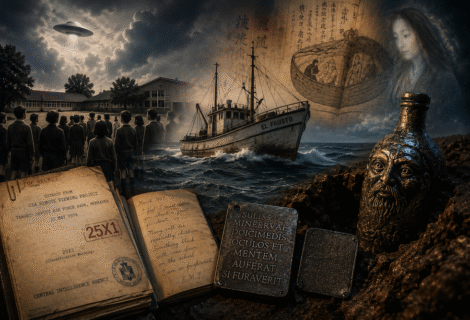
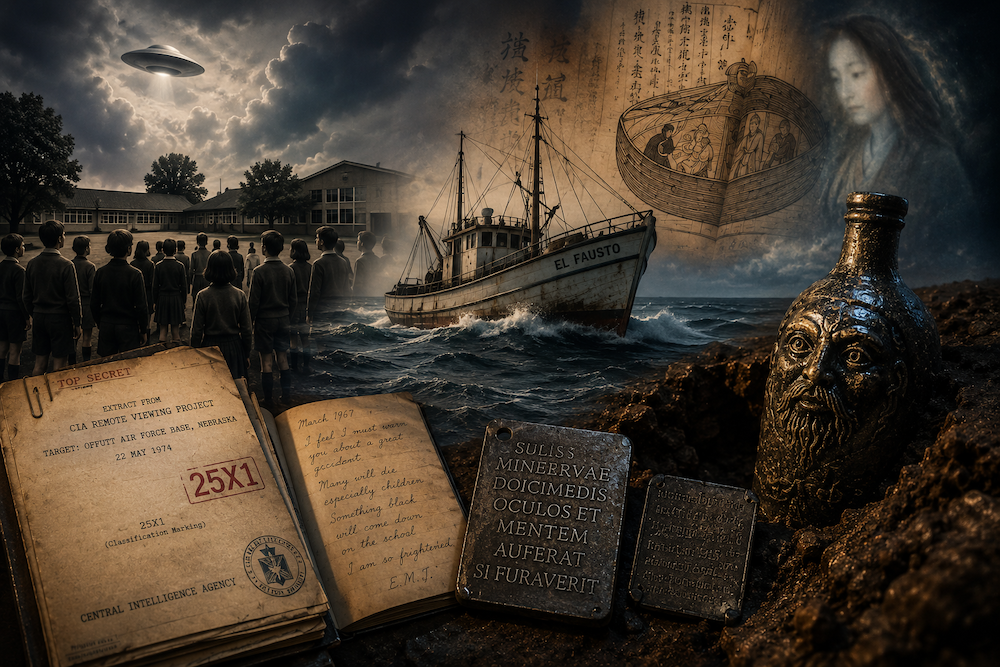
A prediction written down before the event it appears to describe. A child giving details of a life they supposedly never lived. A declassified intelligence file recording an experiment that didn’t behave as expected. Hundreds of people looking towards the same patch of sky. A fishing boat found where it shouldn’t be, only to disappear all over again.
None of those things automatically proves the extraordinary explanation attached to them.
But neither does explaining them away become easier simply because the alternative makes us uncomfortable.
That is where this collection of Antiquities begins: not with what people believe, but with what was actually recorded, witnessed, discovered or left behind.
Some of these stories may ultimately have perfectly ordinary explanations. Others have been exaggerated as they travelled through the years. And occasionally, the evidence itself is genuine while the conclusion people draw from it goes considerably further than the facts allow.
We’ll separate those things wherever we can.
Because a mystery doesn’t become less fascinating when we admit that we don’t know the answer.
Sometimes the most interesting moment comes when you’ve established everything the evidence can tell you…
and realise it has left you with even more questions than you had before.
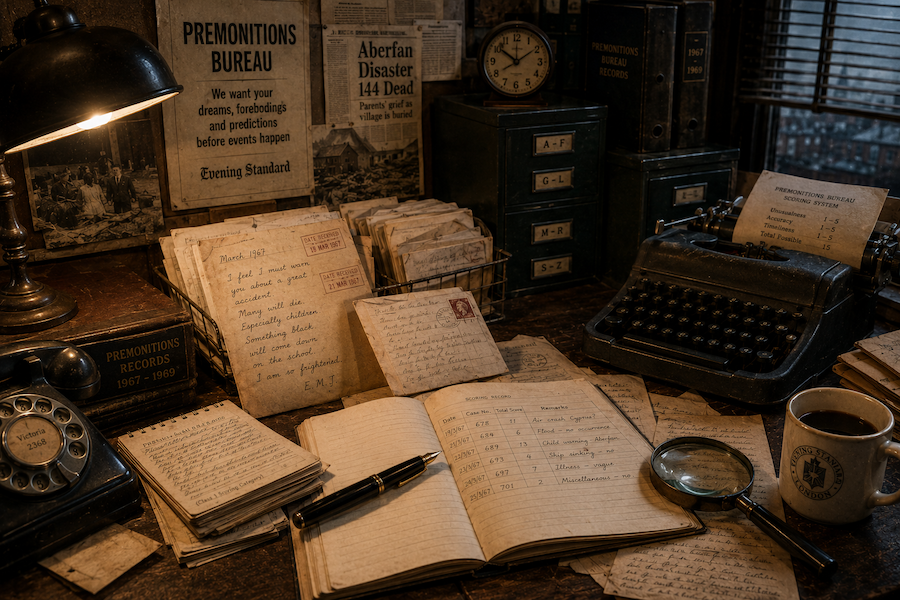
In October 1966, a colliery spoil tip collapsed above the Welsh village of Aberfan, burying homes and Pantglas Junior School beneath thousands of tonnes of slurry.
144 people died, including 116 children.
In the aftermath, psychiatrist John Barker began hearing something else.
Families described dreams, drawings and strange feelings that they believed had predicted the disaster. One particularly haunting account concerned 10-year-old Eryl Mai Jones, who reportedly told her mother the day before the disaster that she had dreamed there was no school because “something black had come down all over it.” Eryl died at Pantglas the following morning.
Most people might have filed such stories under coincidence.
Barker had another idea.
If people really did experience premonitions, collecting them after a disaster was almost useless. Memories could change, details could be unconsciously altered and vague predictions could suddenly appear meaningful once everyone knew what had happened.
So in January 1967, Barker and Evening Standard science editor Peter Fairley created the Premonitions Bureau.
Readers were invited to send in dreams, forebodings and predictions before anything happened. Each submission was dated and recorded, then later compared with real events. The bureau even used a scoring system based on how unusual, accurate and well-timed a prediction appeared to be.
But two contributors began attracting Barker’s attention.
Alan Hencher, a Post Office telephone operator, and Kathleen Middleton, a piano and ballet teacher, repeatedly submitted warnings that Barker considered unusually specific.
In March 1967, Hencher telephoned Barker to describe an approaching aircraft disaster. Barker recorded the prediction beforehand, including Hencher’s belief that the death toll would be around 123 or 124.
One month later, a Bristol Britannia passenger aircraft crashed into a hillside while approaching Nicosia airport in Cyprus. Contemporary reports initially put the death toll at 124, although two more people later died from their injuries.
Hencher had not predicted the disaster perfectly, but the apparent similarity was striking enough for Barker to become increasingly convinced that something worth investigating was happening.
Then the experiment became considerably more personal.
Hencher began warning Barker that his own life might be in danger. Middleton also developed fears concerning Barker’s death.
Barker admitted privately that the predictions frightened him.
On 18 August 1968, aged just 44, John Barker suffered a cerebral haemorrhage and died.
That doesn’t prove Hencher or Middleton could see the future.
The bureau received plenty of predictions that failed completely, and coincidence, selective attention and the temptation to interpret vague statements after an event remain enormous problems when studying supposed precognition.
But the Premonitions Bureau itself was very real.
For a brief period in 1960s Britain, a psychiatrist and a national newspaper genuinely tried to answer an extraordinary question:
If somebody really could predict tomorrow’s disaster, how would we know before tomorrow arrived?
Most children invent stories.
Some invent imaginary friends, impossible adventures or entire worlds populated by people nobody else can see.
But for more than half a century, researchers at the University of Virginia have been studying a rather more difficult group of stories to explain.
Young children, usually between the ages of two and five, begin spontaneously talking about another life.
They may describe another home, another family, a job they once had or even the circumstances in which they claim to have died. The apparent memories usually fade as the child grows older, often disappearing around the age of seven.
This isn’t based on hypnotic regression. In fact, the university’s Division of Perceptual Studies specifically says it doesn’t use hypnosis for this research. Investigators concentrate on spontaneous statements made by very young children.
Over the decades, the division has collected more than 2,500 cases from around the world. In some, researchers have identified a deceased person whose life appears to correspond with details supplied by the child. Around 30% of the cases also involve a birthmark or birth defect reported as corresponding to an injury or mark associated with the deceased person.
There is, however, an obvious problem.
If researchers identify the deceased person before carefully recording what the child originally said, information can become contaminated. Families meet. Stories are exchanged. Memories change. Details that weren’t originally significant suddenly appear important.
The researchers themselves recognised this weakness.
And that’s where a small number of cases become particularly interesting.
Among approximately 2,500 cases examined in one analysis, researchers identified just 24 in which somebody had made a written record of the child’s statements before those statements were verified against a deceased person’s life.
One published investigation concerned a child in Turkey.
Researchers recorded what the child said before identifying the supposed previous personality. They subsequently reported finding detailed correspondences with the life of a man who had lived in Istanbul, roughly 850 kilometres away, and who had died around 50 years before the child was born.
Does that prove reincarnation?
No.
Case studies cannot by themselves establish that a human consciousness survives death and enters another body. Critics can reasonably question information leakage, coincidence, cultural influence, reporting errors and the way matches between statements and deceased people are evaluated.
But dismissing the entire subject as children being hypnotised into telling fantastic stories isn’t accurate either.
There really is a university research programme.
There really are thousands of collected cases.
And, crucially, there are a small number in which researchers attempted to reduce one of the biggest sources of uncertainty by writing down what the child said before anyone went looking for the dead person they appeared to be describing.
Whether that tells us something extraordinary about memory, coincidence, consciousness or something we don’t yet understand is another question entirely.
But it’s a considerably stranger question once the answers have been written down before anyone knows what they’re supposed to match.
For years, stories have circulated that the CIA secretly employed psychics to spy on distant locations.
That sounds exactly like the sort of conspiracy theory Antiquities ought to be suspicious of.
Except this time, the secret programme really existed.
Beginning in the 1970s, US intelligence agencies investigated a supposed ability known as remote viewing: whether a person could describe a distant location or object without seeing it or being told what was there. The work eventually became associated with programmes including GRILL FLAME and STARGATE, and thousands of pages of records have since been declassified.
Among those records is one particularly peculiar experiment.
The intended target was Offutt Air Force Base in Nebraska. A remote viewer was given geographical coordinates and asked to describe whatever was at that location.
There was just one problem.
They didn’t point to Offutt.
They pointed much farther north, to an area near Pisgah, Iowa, beside the Soldier River.
Nobody realised immediately, so the session continued.
Instead of describing an air base, the viewer began talking about what appeared to be wilderness. There were trees, dry ground and something long, narrow and meandering that the viewer initially wondered might be a road before deciding it was probably water. They also described a drop or cliff beside it.
Only afterwards were the coordinates checked.
According to the project’s own analysis, the location they actually indicated contained the Soldier River running through a flat plain with cliffs on either side, in places reaching more than 200 feet high. The report concluded that the viewer’s impressions appeared to correlate well with the geographical features of the mistakenly selected location.
Even more intriguingly, the report noted that the viewer had produced nothing resembling the air base that the experimenters had originally intended them to describe.
It sounds remarkable.
But there’s an important other half to the story.
Remote viewing sessions did not routinely produce results like this. Other declassified reports bluntly record sessions showing “absolutely no target correlation”, and when the programme was independently evaluated in 1995, the intelligence community ultimately concluded that remote viewing was too unreliable and inconsistent to be useful for intelligence gathering.
The programme was discontinued.
So this isn’t proof that somebody psychically travelled to Iowa.
It is something considerably more interesting for Antiquities: a genuine declassified US intelligence document describing an experiment in which researchers accidentally supplied the wrong location, and believed their remote viewer described the wrong location rather than the place they had intended.
Whatever happened in that room, somebody making a typo produced a far stranger experiment than the one they had planned.
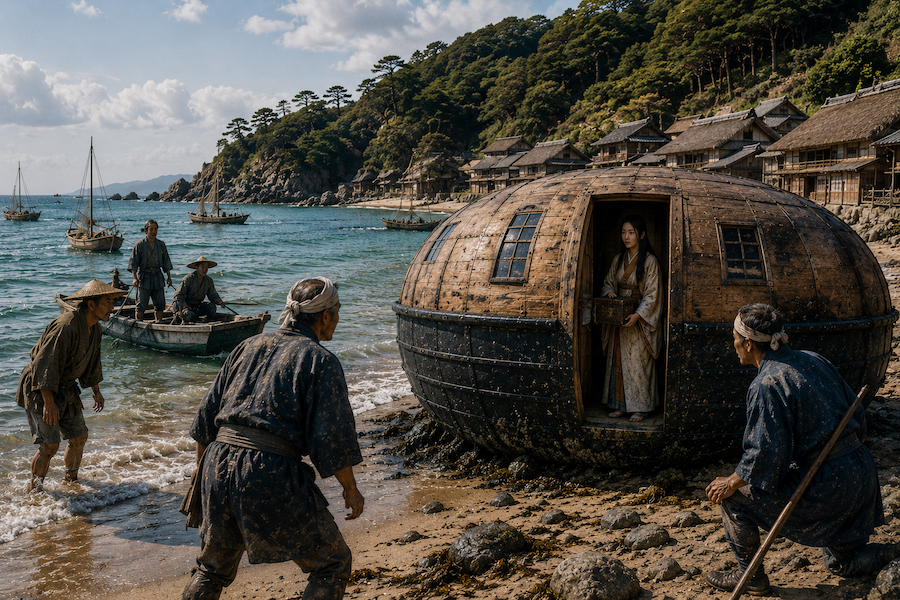
In 1803, according to an extraordinary story recorded during Japan’s Edo period, fishermen on the coast of Hitachi Province spotted something unusual drifting towards shore.
It was round, unlike an ordinary Japanese boat, with a wooden upper section, metal plating around its lower half and windows through which the interior could be seen.
Inside was a young woman nobody could understand.
The story became known as Utsuro-bune, meaning roughly “hollow ship”.
Descriptions vary between surviving accounts, but the central details are remarkably consistent. The woman was described as young, unusually pale, with reddish hair and unfamiliar clothing. She spoke a language the local people couldn’t understand and carried a rectangular box that she reportedly refused to let anyone touch.
Inside the vessel were food, water and bedding.
And on its walls were strange symbols nobody recognised.
It already sounds suspiciously like a modern UFO story.
Then you see the illustrations.
The surviving drawings show a rounded craft with windows and a metallic-looking lower section. To modern eyes, some versions look uncannily like the classic flying saucer that wouldn’t become a fixture of popular culture until more than a century later.
Which inevitably led to a modern claim:
Did Japan record an alien encounter in 1803?
There is one rather substantial problem.
Nobody in the original story said the vessel flew.
It washed ashore.
Japanese researcher Kazuo Tanaka spent years tracking down historical versions of the story. Rather than finding one mysterious manuscript, he eventually identified 11 documents relating to the Hitachi Utsuro-bune legend, including material thought to date remarkably close to the supposed 1803 event.
That makes Utsuro-bune considerably more interesting than a modern internet invention.
It doesn’t, however, make the story literally true.
The surviving sources belong to a culture with an established tradition of strange tales, castaway stories and accounts of mysterious visitors arriving from across the sea. Japan was also living under strict restrictions on foreign contact, so stories about an unfamiliar foreign woman arriving from across the sea would have carried an extraordinary fascination of their own.
Tanaka initially wondered whether the legend might have grown from the wreck of a Russian whaling vessel, but could find no corresponding official record. He ultimately argued against the extraterrestrial interpretation.
And the ending gives us no physical evidence to examine.
Unable to communicate with the woman, the people in the story eventually put her back inside the strange vessel…
and pushed it out to sea.
She disappears from the story as mysteriously as she entered it.
Perhaps Utsuro-bune preserves a distorted memory of a genuine foreign castaway.
Perhaps it is folklore inspired by Japan’s anxieties and fascination with the unfamiliar world beyond its shores.
Or perhaps somebody simply told an exceptionally good story in 1803.
What we cannot reasonably call it is evidence that an alien spacecraft landed in Edo-period Japan.
But more than two centuries before people began talking about flying saucers, Japanese writers really were illustrating a mysterious round vessel, covered in unfamiliar symbols, containing a strange woman nobody could understand.
And frankly, the real history is strange enough without giving the boat an engine and sending it into space.
Imagine going to the public baths, enjoying a relaxing afternoon and returning to the changing area to discover that somebody has stolen your clothes.
Today, you might complain to the staff or report the theft.
In Roman Britain, there was another option.
You could ask a goddess to deal with them.
Around 130 inscribed tablets have been recovered from the sacred spring at Bath, the Roman city of Aquae Sulis. Dating mainly from the second to fourth centuries AD, these small sheets of lead or pewter contain intensely personal appeals to the goddess Sulis Minerva.
Many concern theft.
Money disappeared. Clothes vanished. Bathers apparently returned from the water to discover that someone had helped themselves to their belongings.
And some victims wanted considerably more than an apology.
One man named Docimedis had lost two gloves. His tablet asked that whoever had stolen them should lose their mind and their eyesight.
Another victim, Docilianus, had a hooded cloak stolen. He asked Sulis to deny the thief sleep and children until the cloak was returned.
Someone else apparently decided even that wasn’t enough.
After losing another hooded cloak, a petitioner effectively handed the unknown thief over to Sulis Minerva, declaring that whether the culprit was enslaved or free, male or female, they should only be able to redeem themselves “with their own blood.”
The tablets were deliberately inscribed and deposited in the sacred spring where Sulis Minerva was believed to dwell. In effect, the victim was submitting a supernatural petition for justice.
And because the tablets preserve complaints from ordinary people rather than emperors and generals, they give us an unusually intimate glimpse into everyday Roman life.
People got robbed.
They became furious.
They wanted their possessions back.
And apparently some were perfectly comfortable asking divine forces to make the thief suffer until that happened.
The Bath tablets are now considered important enough to have been placed on the UNESCO Memory of the World UK Register.
Nearly two thousand years later, we can’t know whether any frightened thief ever returned a stolen cloak after developing a sudden inability to sleep.
But we do know that someone in Roman Britain once lost a pair of gloves and decided the appropriate response was to ask a goddess to take the thief’s mind and eyesight.
Some frustrations, it seems, really are timeless.
Perhaps less than we would like. And considerably more than nothing.
None of these stories requires us to believe in reincarnation, precognition, psychic spies, alien visitors or ancient magic. Evidence that something happened is not automatically evidence for every explanation attached to it.
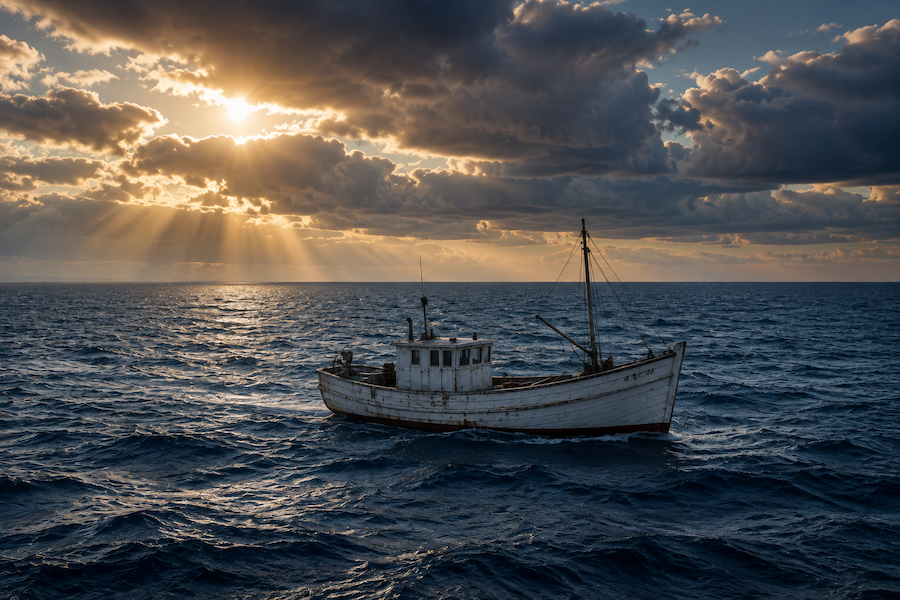
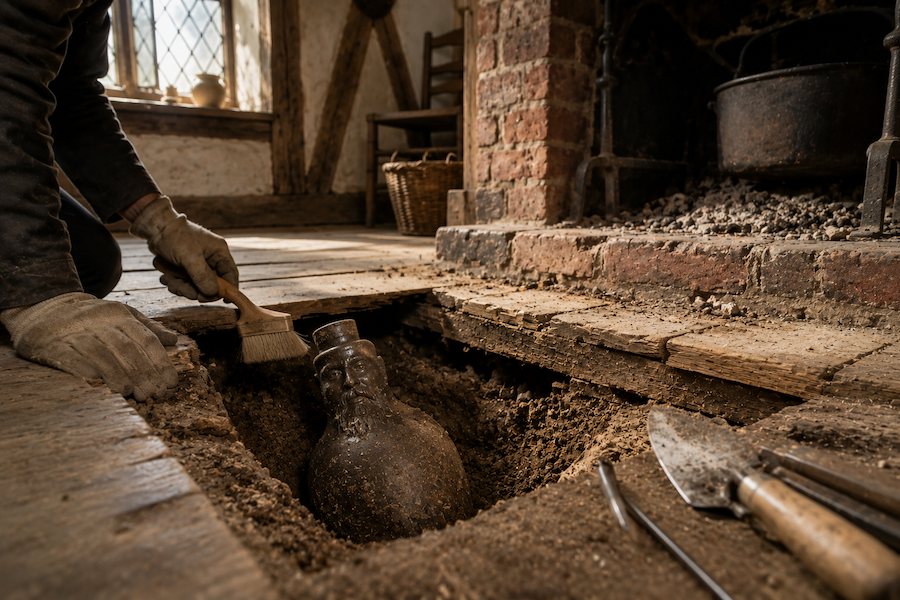
But dismissing the uncomfortable parts doesn’t make them disappear either. The documents still exist. The witnesses still gave their accounts. The bottles were still beneath the floorboards, the curses were still thrown into the spring, and somewhere in the Atlantic three men disappeared from a fishing boat that had already been found once.
Perhaps that is why some mysteries endure.
Not because there is no evidence, but because sometimes the evidence is where the questions begin.
Some of the links on this site are Amazon affiliate links, which means I may earn a small commission if you make a purchase through them – at no extra cost to you. This helps support the blog and keeps the content coming. Thanks for your support!

Sue doesn’t just massage; she awakens your deepest desires. Her intuitive artistry reads your body’s unspoken needs, delivering customised pleasure that leaves you breathless and craving more.
Complete relaxation + targeted pleasure
Stress relief + sensual awakening
Slow, energy-building ecstasy
Spiritual + physical connection
Fantasy fulfilment
Personalised pleasure
Prostate + sacred masculine energy
Men seeking profound release
Deep feminine healing + orgasmic waves
Women embracing sensuality
Shared intimacy + guided exploration
Reigniting passion
🌶️ Sue’s After Dark Diaries Ep 49 – The Rabbit Mark Thought Dan Needed
The World is Stranger Than You Think | Antiquities No. 2
When Desire Doesn’t Match: Understanding Mismatched Desire
The Treasure Hunt Nobody Finished Part 2
The Treasure Hunt Nobody Finished Part 1
🌶️ Sue’s After Dark Diaries Episode 48: The Parcel Definitely Wasn’t Mine
Things That Sound Completely Made Up, But Aren’t | Antiquities No. 1
When the Lights Went Out | A Power Cut Sensual Story | Breathless
Hey, my deliciously daring darlings… I can practically feel the secrets tingling between your toes. That midnight tiptoe across a hotel carpet, the sly brush of an ankle under the dinner table, the time your feet led you straight into trouble, and you loved every scandalous second.
Why hoard those toe-curling tales? Kick off your heels, wiggle free, and spill the juiciest, most wicked foot-fetish confessions you’ve got. I want the stories that make my pulse race, my cheeks flush, and my soles itch to join the fun.
Think you’ve got what it takes to make me squirm? Slide your steamiest secret into my inbox at [email protected] . Fair warning: I’m hard to shock… but a bold, barefooted confession? That just might do it.