
The cold years are coming

The Cold Years Are Coming
Written by Sue
Author of After-Dark Diaries
🌍 Introduction for Readers
The Cold Years Are Coming, forget the headlines warning of unending heatwaves and boiling oceans. There’s another reality quietly taking shape—a colder one. Behind the curtain of mainstream climate narratives lies a powerful force driving our planet’s transformation: the Grand Solar Minimum. It’s a solar cycle the world has seen before, one that brings colder temperatures, food shortages, civil unrest, and geopolitical upheaval.
But unlike in the past, this time the elites are preparing—and staying eerily silent about what’s coming for the rest of us. Why?
Because panic is bad for control, and clarity is dangerous to agendas. This article exposes what the Grand Solar Minimum really is, why the truth is being buried, and what it could mean for every single one of us in the coming decade.
❄️ Understanding the Grand Solar Minimum
The Grand Solar Minimum (GSM) isn’t speculation—it’s an established solar phenomenon. The Sun operates on roughly 11-year activity cycles, and every few centuries, it enters a prolonged period of unusually low solar activity. When this happens, sunspots virtually disappear, and Earth receives significantly less solar radiation. That decrease causes a cascade of climate effects that include colder global temperatures, increased precipitation, disrupted atmospheric currents, and shortened growing seasons.
We’ve lived through this before. Between 1645 and 1715, during the Maunder Minimum, much of Europe was plunged into what’s now known as the Little Ice Age. Rivers froze solid, crops failed repeatedly, and entire villages perished. Famines swept across the Northern Hemisphere. Harsh winters weren’t the exception—they became the norm for decades. Another event, the Dalton Minimum (1790–1830), brought similar suffering and coincided with the massive eruption of Mt. Tambora, which led to the infamous “Year Without a Summer” in 1816. Crops withered in snowstorms… in June.
We’re now entering what some scientists call the Modern Grand Solar Minimum, projected to span from 2020 to around 2053. Unlike global warming, which has taken center stage in public discourse, the GSM has been quietly omitted from climate debates—despite its measurable effects already being felt.
NASA, NOAA, and space weather research communities have published data showing that solar cycle 25 is already underperforming in terms of sunspot activity. That’s not conspiracy—it’s observation.
You can read NASA’s data for yourself here:
🔗 NASA Solar Cycle 25 Prediction
So, if the science is sound and the signs are visible, why is no one talking about it?
🕵️♂️ Why They’re Not Telling You
Because acknowledging the Grand Solar Minimum would unravel too many tightly held narratives.
For decades, climate policy has been built on the assumption that anthropogenic global warming—driven by fossil fuels and human activity—is the sole cause of climate change. This belief underpins international treaties, carbon markets, green energy mandates, and sweeping global economic shifts.
But if the public knew the Earth is naturally cooling due to solar behaviour—despite rising CO₂ levels—they might start asking dangerous questions. Questions like:
-
Why are we paying carbon taxes?
-
Why are we transitioning to solar and wind during a cooling period?
-
Why are we being told the planet is burning, while food production quietly collapses due to cold and wet weather?
Rather than allow the Grand Solar Minimum to complicate the narrative, the response has been to reframe its effects:
-
Record-breaking snowstorms are now labeled “extreme weather.”
-
Cold summers? “Climate chaos.”
-
Floods destroying crops in Europe and Asia? “Unpredictable climate variability.”
The messaging subtly avoids any mention of solar cycles—or the role of the Sun.
Worse, some elites are profiting from the confusion, quietly betting on land, commodities, and technologies that will thrive in the cold years ahead.
🧠 Government Silence & Narrative Control
Why isn’t the public told about the Grand Solar Minimum (GSM)?
-
It contradicts the global warming–only narrative
-
It undermines carbon taxes, energy regulations, and green tech investments
-
It could lead to mass panic over food and energy
Instead: governments and media reframe GSM symptoms as “climate emergencies” caused by CO₂.
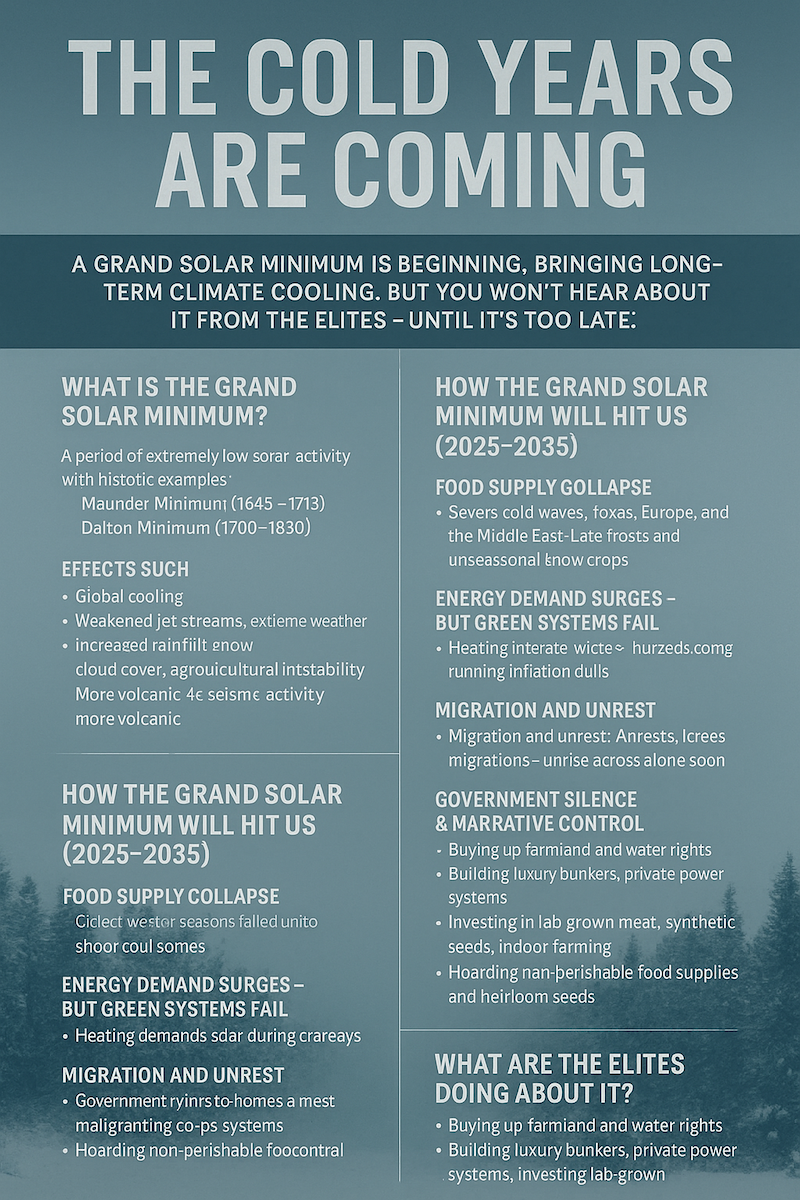
🌾 Food Supply Collapse
-
Colder, wetter seasons → failed crops
-
Shorter growing periods (especially for wheat, corn, rice)
-
More pests and plant disease due to altered weather cycles
-
Increased reliance on lab-grown food and synthetic proteins
Outcome: Mass food shortages, government rationing, and runaway price inflation.
🌍 Migration and Unrest
-
Crop collapse in one region → mass migration to another
-
Cold climates become less habitable
-
Climate-related conflicts escalate
Outcome: Border crises, political chaos, and the rise of climate authoritarianism.
⚡ Energy Demand Surges – But Green Systems Fail
-
Heating demands soar during long, cold winters
-
Solar panels underperform during cloudy GSM conditions
-
Wind turbines fail under ice, snow, and erratic gusts
Outcome: Energy blackouts, rising bills, and mounting pressure to accept centralized “green” energy control.
🌾 Food: The Coming Battlefield
Arguably the most direct impact of the Grand Solar Minimum will be on agriculture. Modern farming operates on razor-thin margins of temperature, rainfall, and sunlight. Even a slight shift in growing conditions can decimate harvests. A two-week delay in spring, an unexpected frost, or prolonged cloud cover can mean the difference between abundance and collapse.
Already, there are widespread warnings of grain shortages. Wheat crops in the Northern Hemisphere are failing under late frosts and torrential rains. Farmers are battling mould, fungus, and shortened growing seasons. Crops that once thrived in temperate zones are being pushed further south—or failing outright.
Yet again, few point to solar activity. The blame is deflected to “climate change” or “weather volatility.” While technically not untrue, this framing conveniently omits the role the Sun’s energy output plays in regulating Earth’s climate systems.
Meanwhile, billionaire investors like Bill Gates are buying up millions of acres of farmland—especially in climate-stable regions like the American Midwest. Why? Because when food becomes scarce, those who control it will control everything. Gates has also invested heavily in synthetic meat, seed technologies, and bioengineering platforms. The goal seems clear: when traditional food systems break down, the public will be steered toward patented, centralised, and tightly controlled alternatives.
🏦 What Are the Elites Doing About It?
They’re not ignoring it—they’re preparing:
-
Buying up farmland and water rights in climatically stable regions
-
Building luxury bunkers, off-grid retreats, and private power systems
-
Investing in lab-grown meat, synthetic seeds, and indoor farming
-
Hoarding non-perishable food supplies and heirloom seeds
-
Quietly funding geoengineering projects to manipulate weather
Billionaires like Gates and Bezos have quietly accumulated vast agricultural landholdings. Why? Because in the cold years to come, food will be the new gold.
🔬 Geoengineering and Weather Control
If the elites know what’s coming, why not mitigate it? That’s where geoengineering enters the conversation—a once-taboo subject now openly discussed at climate summits and inside military research labs.
Projects include stratospheric aerosol injection, where reflective particles are released into the upper atmosphere to bounce sunlight away from Earth. Other proposals involve manipulating cloud cover, ocean alkalinity, and even jet stream patterns. These aren’t fringe ideas. Harvard’s Solar Geoengineering Research Program and multiple U.S. military documents outline the feasibility and strategic value of climate manipulation.
The concern, however, is not that geoengineering doesn’t exist—it’s that it’s being considered or deployed without public consent, and possibly with unintended consequences. Could it be that weather patterns are already being influenced in experimental ways, further confusing public understanding of natural versus artificial climate shifts?
What’s certain is this: If food scarcity, cold weather, and erratic rainfall intensify, the demand for “solutions” will skyrocket. And those who control the solutions will gain unimaginable power.
🧲 The Earth’s Magnetic Field: Another Layer
While less talked about, the Earth’s weakening magnetic field adds yet another layer of complexity. Scientific observations show that Earth’s magnetic strength has declined over the past century and that the magnetic poles are moving faster than ever recorded.
A weaker magnetic field means more cosmic radiation reaching Earth, which can affect weather systems, human health, and even infrastructure. The GSM appears to correlate with these magnetic shifts. In past minima, such weakening has sometimes preceded pole reversals, which, while rare, are not impossible.
The implications? Increased radiation exposure for airline passengers, satellite and GPS malfunctions, and higher risk of geomagnetic storms that could wipe out entire electrical grids. Again, no one’s sounding the alarm. It’s not good for business or elections.
🌐 The Bigger Picture: Solar Activity & Earth’s Magnetic Field
The Sun’s decreased activity may also weaken Earth’s magnetosphere, exposing the planet to:
-
More cosmic radiation
-
Satellite and GPS disruptions
-
Mood swings, health issues, and unknown biological effects
-
Potential triggers for magnetic pole shifts, which Earth has experienced before
Are we being slowly acclimated to digital ID, programmable money, and biometric surveillance in preparation for chaos? That’s not a conspiracy—it’s a growing suspicion among independent researchers and ex-intelligence analysts.
🔍 What’s Happening Now?
From 2020 onward, Earth has experienced:
-
Severe cold waves in Texas, Europe, and the Middle East
-
Late frosts and unseasonal snow destroying crops
-
Massive flooding disrupting agriculture in Pakistan, China, and Italy
-
Spikes in food prices, attributed vaguely to “climate change” or “supply chain issues”
But the elephant in the room—solar-driven climate disruption—is rarely addressed.
🕰️ When Will It Hit Hard?
While the world is already seeing early tremors, the true force of the Grand Solar Minimum will be felt in phases. Between 2025 and 2035, the most dramatic effects are expected to surface. This includes the peak of cold-related agricultural failures, the energy system strain from extended winters, and the political fallout from global food shortages.
But perhaps the more insidious danger is not a single catastrophic moment—it’s the gradual erosion of systems we take for granted. Each year, the growing season gets a little shorter. Each winter, a little harsher. The crops produce a little less, and the prices rise a little higher. Eventually, we cross a threshold—and then the scramble begins.
By 2030, many believe we’ll be in the thick of it. Governments may implement food rationing, energy lockdowns, or climate-based martial law to maintain order. The infrastructure simply isn’t built to handle this kind of long-term pressure.
📆 When Will It Hit the Average Person?
| Year | Event Phase | Key Impacts
|
|---|---|---|
| 2020–2025 | Onset | Weather extremes, food inflation |
| 2025–2030 | Tipping Point | Major crop losses, energy crisis |
| 2030–2040 | Deep Minimum | Food rationing, social unrest, control |
| 2040–2053 | Unknown territory | Tech failures, possible pole shift |
The next 5–10 years will see the biggest shocks to the public—especially through food availability, energy security, and weather instability.
🧠 What Can We Do?
The truth is, we won’t all be able to escape to private islands or climate-controlled bunkers. But there are things people can do now:
-
Grow your own food, even in small quantities. Learn about indoor growing systems and heirloom seeds.
-
Diversify your energy sources—solar may struggle, so consider backups.
-
Understand your local climate’s historical patterns, not just recent media narratives.
-
Most importantly, share this knowledge. The more people are aware, the more communities can begin preparing together.
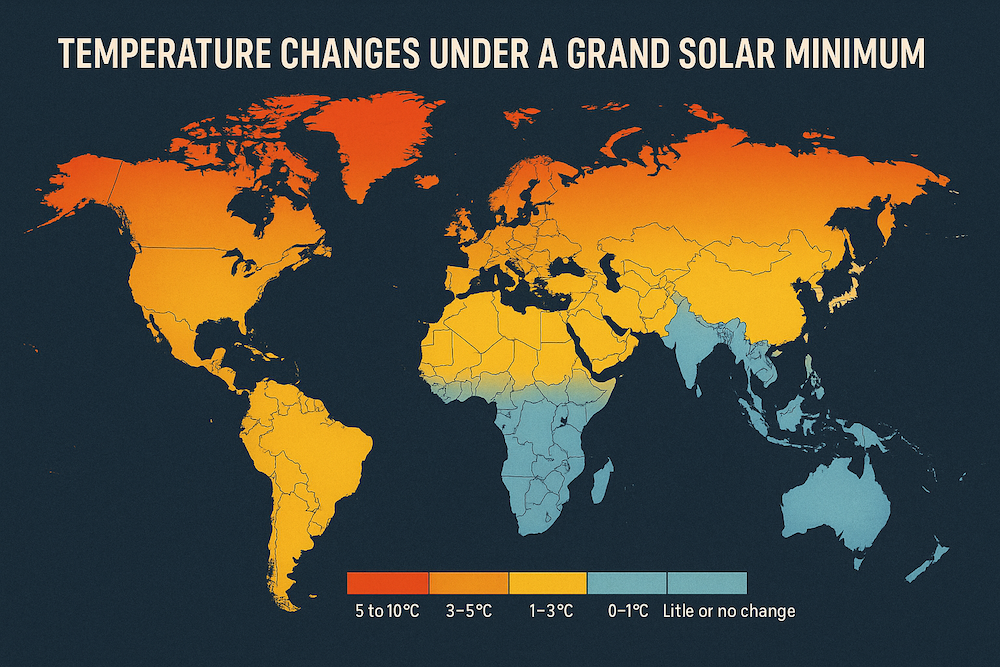
🌍 Regions Likely to Be Most Severely Affected by GSM
1. Northern and Central Europe
-
Countries: UK, Germany, Poland, Scandinavia (Norway, Sweden, Finland), Austria, Switzerland, Czech Republic, Netherlands
-
Estimated temperature drop: 2°C to 5°C
-
Likely effects: Harsh winters, shorter growing seasons, crop failure due to late frosts, increased flooding from snow melt and rain
2. Canada & Northern USA
-
Regions: Alberta, Saskatchewan, Quebec, New England, Great Lakes, Montana, North Dakota, Minnesota
-
Estimated temperature drop: 2.5°C to 5°C
-
Likely effects: Deep freezes, disrupted agriculture, fuel shortages, infrastructure stress, migration pressure
3. Russia & Former Soviet States
-
Countries: Russia (especially Siberia, western Russia), Ukraine, Belarus, Kazakhstan
-
Estimated temperature drop: 2.5°C to 6°C
-
Likely effects: Extreme cold events, loss of permafrost stability, severe agricultural collapse in northern zones
4. China & Mongolia (Northern & Central)
-
Estimated temperature drop: 2°C to 4.5°C
-
Likely effects: Damaged wheat and rice crops, fuel demand spike, mass internal migration, food scarcity
⚠️ Moderately Affected Regions
5. Eastern & Central USA
-
Regions: Midwest (Iowa, Illinois), Appalachia, Mid-Atlantic, Northeast
-
Estimated temperature drop: 1.5°C to 3.5°C
-
Likely effects: Crop disruptions, increased heating costs, greater storm volatility
6. Northern India, Nepal, Bhutan
-
Estimated temperature drop: 1.5°C to 3°C
-
Likely effects: Disruption to monsoon patterns, food instability, glacial anomalies
7. Japan & Korea
-
Estimated temperature drop: 1.5°C to 3.5°C
-
Likely effects: Increased snowfall, risk to rice production, supply chain interruptions
⚖️ Mildly Affected or Buffer Zones
8. Australia (Interior)
-
Estimated temperature drop: 0.5°C to 2°C
-
Likely effects: Some agricultural shift, less rain inland, population clustering toward coasts
9. Southern USA (Texas, Florida, Arizona)
-
Estimated temperature drop: 0.5°C to 1.5°C
-
Likely effects: More tolerable climate, possible influx of population, pressure on water systems
10. South America (Brazil, Argentina, Chile)
-
Estimated temperature drop: 1°C to 2.5°C (southern regions more affected)
-
Likely effects: Delayed growing seasons, more floods or frosts in southern latitudes
✅ Least Affected or Possibly Benefitting Zones
11. Tropical Africa (Equator regions)
-
Estimated temperature change: ±0.5°C or minimal
-
Likely effects: May become a refuge zone for food production; however, rainfall shifts could occur
12. Southeast Asia (Thailand, Malaysia, Indonesia)
-
Estimated temperature drop: <1°C
-
Likely effects: Minimal direct temperature effects, but may see shifts in rainfall and typhoon patterns
13. New Zealand
-
Estimated temperature drop: 0.5°C to 1.5°C
-
Likely effects: Minor disruption, stable food systems, possible migration destination
14. Equatorial South America (Ecuador, Colombia, Peru)
-
Estimated temperature drop: <1°C
-
Likely effects: Potential stability in food production zones, but vulnerable to rainfall variability
📌 Important Notes:
-
These are historical analog-based estimates, not precise predictions.
-
Local microclimates, oceanic patterns (like El Niño), and geoengineering efforts could alter outcomes.
-
GSM effects may intensify between 2025–2040, then stabilize or reverse, depending on solar cycles.
🚨 Final Thought
The Cold Years Are Coming. Not as metaphor. Not as theory. But as a scientifically validated reality, backed by centuries of precedent. We are entering a cold, chaotic age—masked by political silence and media misdirection.
The Grand Solar Minimum has already begun. Its effects are in motion. And those in power know it.
It’s a natural cycle with historical precedent, scientific validation, and world-shaping implications.
They are preparing—quietly—while keeping the public docile through conflicting narratives and pacifying distractions.
The question isn’t if it’s coming, or whether you should worry.
It’s why you haven’t been told…
And whether you’ll act before it’s too late to ask why no one ever warned you.
📌
If this article struck a nerve, share it. Censorship is rising, but knowledge is still power.
We’re not helpless—but we are on our own if we don’t wake up soon.

🗣️ We’d Love to Hear From You
Have you experienced unusual weather patterns or disruptions to food production in your region? Do you have insight into what local authorities or private groups are doing to prepare for the coming changes? Perhaps you have a story, a theory, or a concern that needs exploring.
We invite you to share your thoughts, experiences, or questions. Leave a comment below, or email us directly at [email protected]. Your insight could help shape a future article and bring critical information to light.
We’re especially keen to hear from:
-
Independent farmers and growers
-
Scientists, weather observers, and researchers
-
Anyone noticing strange shifts in seasons or food supply
If there’s a topic you’d like us to dig deeper into, don’t hesitate to reach out. This is a community effort—and your voice matters.





Recent Comments